




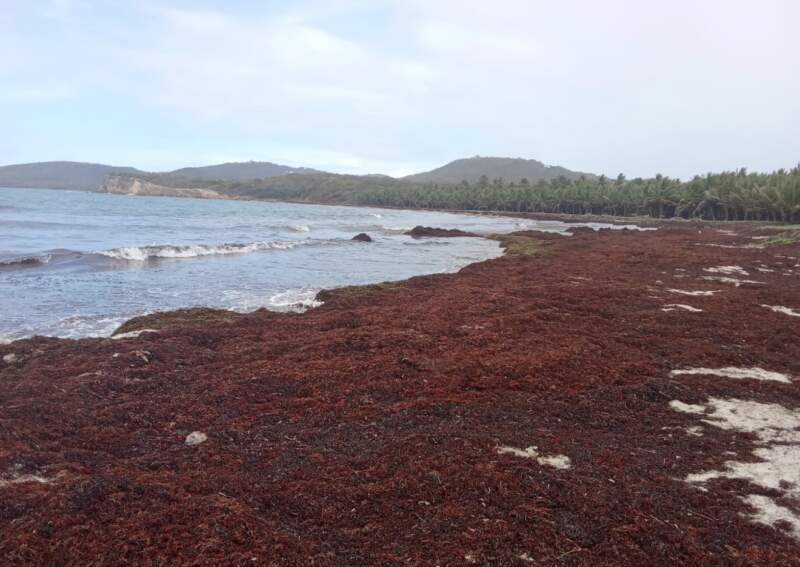
Sargassum is not just a matter of scientific expertise or administrative management. For many residents, it is also a daily reality marked by unpleasant odors, health concerns, a deterioration of their living environment, and questions about public accountability.
Following Professor Pascal Saffache’s remarks on Martinique la 1ère on May 28, Catherine Jean-Baptiste sent us this contribution. It is not intended to dismiss recognized scientific expertise, but rather to broaden the debate by pointing out that sargassum strandings affect »scope" that goes far beyond in some of the most visible areas of the coastline. Drawing on several scientific and legal references, she urges us to consider these algae as a form of pollution when they contain high concentrations of substances of particular concern, and raises questions about the authorities’ response to a phenomenon of such magnitude and now a recurring occurrence.
This article is published as a reasoned opinion piece. It reflects the views of its author and aims to contribute to the public debate on Sargassum management in Martinique. Antilla emphasizes the importance of exchanging perspectives while respecting individuals, scientific research, and the lived experiences of the affected communities.
Is it urgent to do nothing and let the Sargassum seaweed wash up on our shores?
by Catherine Jean-Baptiste
Our response is:
«Sargassum is POLLUTION»
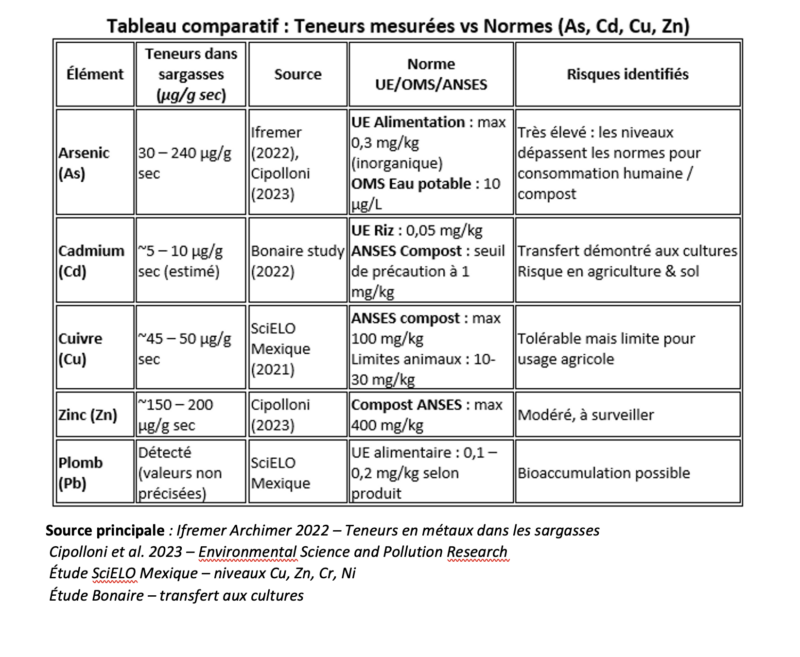
Key Findings:
- Arsenic is the element of greatest concern, particularly its highly toxic inorganic form.
- Sargassum is bioaccumulators effective : They concentrate marine pollutants through the alginates present in their structure.
- As compost or soil amendment, The release of heavy metals has been demonstrated, with transfer to vegetables or soil contamination.
- The measured concentrations regularly exceed the standards, if the intended use (compost, animal feed, human consumption).
 Regarding thea The Chlordecone Issue and its accumulation by the Sargassum
The Martinique Marine Nature Reserve conducted experiments in 2021 on retention dams between Le François and Le Vauclin. This research shows that Sargassum actively accumulates the chlordecone as they drift toward polluted coastal areas:
«It has been shown that algae absorb chlordecone present in nearshore waters.» https://parc-marin-martinique.fr/actualites/etude-sur-la-contamination-des-sargasses-par-le-chlordecone
… and with the risk of pollution at storage sites
The BRGM, in a 2022 study, notes that backshore disposal sites sometimes contain concentrations of chlordecone. The alkaline leaching of decomposed Sargassum may cause the remobilization or transfer of chlordecone into soil and water surrounding.
And what do the authorities responsible for the quality of our environment have to say? ?
–« these algae s»are natural, so you can't activate a POLMAR,", or any other device appropriate for the situation »
…and what if they run aground? ? :
–« …but, They're trash; they're so local governments that are responsible for managing in light of their skills »
…thus flouting the Constitutional Law No. 2005-205 of March 1, 2005 (Charter of the environment )
Excerpts :
« That environmental protection must be pursued on the same footing as the nation’s other fundamental interests ; »(…)
« Article 1. Everyone has the right to live in a balanced environment that is conducive to good health.
Article 2. Everyone has a duty to help preserve and improve the environment.
Article 3. Every person must, under the conditions set forth by law, prevent any harm they may cause to the environment or, failing that, limit the consequences of such harm.
Article 4. Every person must contribute to the remediation of environmental damage they cause, under the conditions established by law.
Article 5. When the occurrence of harm—even if uncertain given the current state of scientific knowledge—could seriously and irreversibly affect the environment, public authorities shall, in accordance with the precautionary principle and within their respective areas of authority, ensure the implementation of work from risk assessment procedures and the adoption of provisional and proportionate measures to prevent damage from occurring.
….»
…You be the judge!!!