




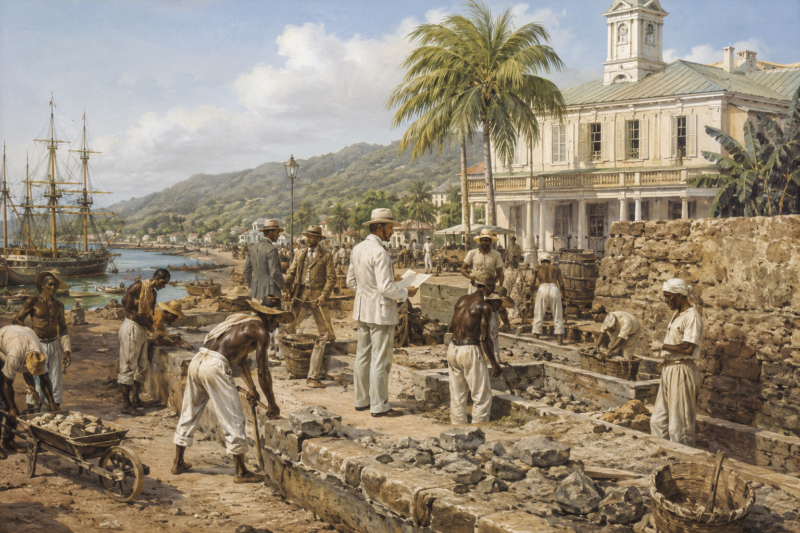
In response to Gérard Dorwling-Carter’s article, «Historical Facts Every Martinican Should Remember,» Catherine Jean-Baptiste urges readers to take a broader view. She points out that, during the colonial period, civilian expenditures and a large portion of the investments made in the colonies were primarily financed by taxes and resources collected locally, rather than by taxpayers in mainland France.
«I would respond to Gérard Dorwling-Carter with a historical fact that every French person should keep in mind,»,
writes Catherine Jean-Baptiste.
It refers to the principle of financial autonomy for the colonies, enshrined in Article 33 of the Finance Act of April 13, 1900. That law provided that civil expenditures and those of the gendarmerie were, in principle, to be covered by the colonies’ budgets. However, state subsidies could be granted to them when their resources were insufficient.
In practice, colonial administrations thus had budgets largely funded by taxes, fees, and revenues collected in the territories in question. Roads, schools, hospitals, water systems, and other public infrastructure were therefore primarily financed by the local populations.
To support her argument, Catherine Jean-Baptiste refers to a France Culture segment titled « No, the French did not pay for colonization ». Historian Camille Lefebvre points out that civilian expenditures in the colonies were funded primarily from their own resources, and that the money coming from mainland France was used mainly for military expenditures.
Recent economic research conducted by Denis Cogneau, Yannick Dupraz, Élise Huillery, and Sandrine Mesplé-Somps reaches a similar conclusion. According to their study of the French colonial empire between 1833 and 1962, France’s public spending amounted to approximately 1.3 % of metropolitan gross domestic product, nearly four-fifths of which was allocated to the military.
Catherine Jean-Baptiste points out that the West Indies were not exempt from this system. In particular, she cites the history of the Gueydon Fountain, inaugurated in 1856 to supply Fort-de-France with running water, serves as an example that raises questions about the true source of funding and the contribution of Martinicans to infrastructure projects presented as achievements of the colonial administration. The Gueydon Fountain’s primary function was, in fact, to supply the city with water.
This clarification is not intended to deny that the French government incurred expenses in the colonies. Rather, it aims to distinguish between military and administrative expenditures and civilian investments, and to point out that the colonized populations contributed significantly to the financing of infrastructure built on their own territories.
This historical reality calls into serious question the notion that colonization constituted, for the affected populations, a development policy funded solely by the generosity of the mother country.
Catherine Jean-Baptiste