



Close Menu
ANTILLA MARTINIQUE | Avec vous depuis 1981

    Subscribe

    Get the latest creative news from ANTILLA on art, design, and business

    Current Trends

    Transports : l’unité et la responsabilité pour réussir la rentrée scolaire

    August 14, 2026

    Diversification agricole : la Martinique doit obtenir une réforme structurelle du POSEI

    August 14, 2026

    « Que représente la CARICOM pour la jeunesse ? » : La jeunesse caribéenne répond

    August 14, 2026
    Facebook X (Twitter) Instagram
    ANTILLA MARTINIQUE | Avec vous depuis 1981ANTILLA MARTINIQUE | Avec vous depuis 1981
    • Sections
      • Editorial by Henri PIED
      • Ecology / Environment
      • Art/Culture
      • Caribbean
      • Companies
      • Gdc's Perspective
      • Heritage
      • Politics
      • Health
      • Sports
      • Opinion Pieces
    • Our Files
      • Great Figures
        • Édouard Glissant
        • Aimé Césaire
        • Frantz Fanon
        • Pierre Aliker
        • Camille Darsières
        • Alfred Marie-Jeanne
        • Patrick Chamoiseau
        • Raphaël Confiant
        • Serge Letchimy
      • Key Issues
        • Sargassum
        • Rum
        • High Cost of Living
        • The Press in Martinique
      • Profile or Investigation
    • About
      • About Us
      • Media Kit
    • Contact
    • Change language to Français
    annonces
    SUBSCRIPTION
    ANTILLA MARTINIQUE | Avec vous depuis 1981
    Home » Colonization: Who Really Financed the Infrastructure? By Catherine Jean-Baptiste
    Opinion Pieces

    Colonization: Who Really Financed the Infrastructure? By Catherine Jean-Baptiste

    August 5, 2026No Comments
    Facebook LinkedIn WhatsApp

    In response to Gérard Dorwling-Carter’s article, «Historical Facts Every Martinican Should Remember,» Catherine Jean-Baptiste urges readers to take a broader view. She points out that, during the colonial period, civilian expenditures and a large portion of the investments made in the colonies were primarily financed by taxes and resources collected locally, rather than by taxpayers in mainland France.

    «I would respond to Gérard Dorwling-Carter with a historical fact that every French person should keep in mind,»,

    writes Catherine Jean-Baptiste.

    It refers to the principle of financial autonomy for the colonies, enshrined in Article 33 of the Finance Act of April 13, 1900. That law provided that civil expenditures and those of the gendarmerie were, in principle, to be covered by the colonies’ budgets. However, state subsidies could be granted to them when their resources were insufficient.

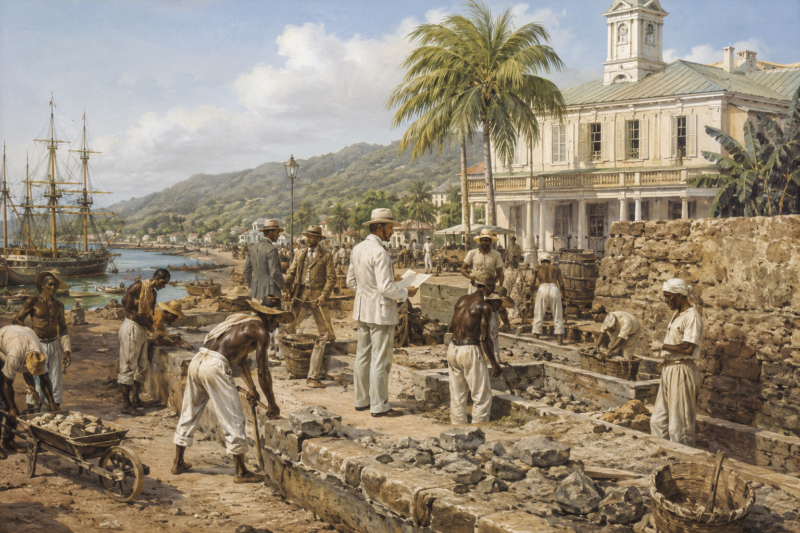
    In practice, colonial administrations thus had budgets largely funded by taxes, fees, and revenues collected in the territories in question. Roads, schools, hospitals, water systems, and other public infrastructure were therefore primarily financed by the local populations.

    To support her argument, Catherine Jean-Baptiste refers to a France Culture segment titled « No, the French did not pay for colonization ». Historian Camille Lefebvre points out that civilian expenditures in the colonies were funded primarily from their own resources, and that the money coming from mainland France was used mainly for military expenditures.

    Recent economic research conducted by Denis Cogneau, Yannick Dupraz, Élise Huillery, and Sandrine Mesplé-Somps reaches a similar conclusion. According to their study of the French colonial empire between 1833 and 1962, France’s public spending amounted to approximately 1.3 % of metropolitan gross domestic product, nearly four-fifths of which was allocated to the military.

    Catherine Jean-Baptiste points out that the West Indies were not exempt from this system. In particular, she cites the history of the Gueydon Fountain, inaugurated in 1856 to supply Fort-de-France with running water, serves as an example that raises questions about the true source of funding and the contribution of Martinicans to infrastructure projects presented as achievements of the colonial administration. The Gueydon Fountain’s primary function was, in fact, to supply the city with water.

    This clarification is not intended to deny that the French government incurred expenses in the colonies. Rather, it aims to distinguish between military and administrative expenditures and civilian investments, and to point out that the colonized populations contributed significantly to the financing of infrastructure built on their own territories.

    This historical reality calls into serious question the notion that colonization constituted, for the affected populations, a development policy funded solely by the generosity of the mother country.

    Catherine Jean-Baptiste

    Related Posts

    «What if the real change were a shift in Martinican political culture?» By Franck A

    August 11, 2026

    BACCHA FESTIVAL: A Resounding Success—When the Facts Speak for Themselves!

    August 10, 2026

    French West Indies: Is “Europeanization” the New Horizon?

    August 10, 2026
    Add A Comment

    Comments are closed.

    Caribbean News
    Caribbean

    « Que représente la CARICOM pour la jeunesse ? » : La jeunesse caribéenne répond

    St Lucia Times PaKherim Nelson À l’occasion de la Journée internationale de la jeunesse, les jeunes des Caraïbes ont pu exprimer à la CARICOM ce…

    Les centres de formation technique et professionnelle de Sainte-Lucie se font l’écho de l’appel régional aux compétences

    August 14, 2026

    Saint Lucia Officially Launches a 1,000 EC$ Allowance for Newborns

    August 4, 2026

    OECO delegates review Sargassum management strategies following their mission to French territories

    August 2, 2026

    Pierre: Emancipation is incomplete without economic freedom.

    August 2, 2026
    SUBSCRIBE TO OUR CHANNEL!
    Post Your Legal Notices

    Subscribe

    Get the latest news from Antilla Martinique.

    Thank you! Your request has been received.

    View legal notices
    View our back issues
    Our Different Sections
    Archives
    © 2026 Copyright ANTILLA. All rights reserved. Programmed by ANTILLA.
    • CONTACT
    • MARKETING
    • LEGAL NOTICE
    • LEGAL NOTICES
    • ABOUT ANTILLA

    Type above and press Enter to search. Press Esc to cancel.