




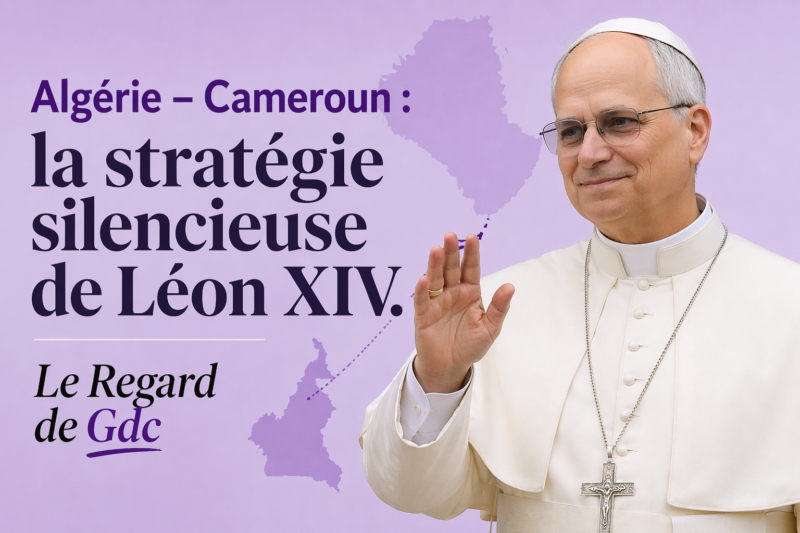
Far from being merely a pastoral visit, Pope Leo XIV’s trip to Algeria and Cameroon outlines a coherent vision of the Church’s role in the contemporary world: to be a presence where it is in the minority, and to exercise responsibility where it is in the majority.
The choice of Algeria and Cameroon reflects a strategic interpretation of Catholicism in the 21st century.
In these two countries, the situation of the Church could not be more different. In Algeria, it is a minority, almost invisible, and part of a predominantly Muslim society. In Cameroon, it is deeply rooted, influential, and helps shape social and cultural life.In Algeria, the pope proposes a theology of presence. The Church there seeks neither to convert nor to impose itself.
She adopts an attitude of selflessness: simply being there, without expecting anything in return. This approach breaks with the historical logic of conquest and is rooted in a dynamic of relationship-building, dialogue, and discreet service.
The martyrs of Algeria—from Tibhirine to Bishop Claverie—embody this silent fidelity: to love to the very end, without seeking to dominate, in the spirit of bearing witness.
In Douala, on the other hand, the tone changes. There, the Church is visible and powerful. Leo XIV then adopts a stern tone. Addressing the crowd, he asks, «What are you doing for others?» Faith cannot be merely a proclamation here; it becomes a responsibility. The pope denounced corruption, inequality, and waste,
and calls on young people to reject violence and the illusion of easy gains. Here, faith must lead to action.
This two-pronged approach reveals a clear principle: the Church cannot adopt a single, universal stance.
It must adapt to local realities. When in the minority, it provides input. When in the majority, it takes action and is accountable.
Beyond its religious significance, this trip has geopolitical implications. It places Africa at the heart of global Catholicism and offers an alternative to traditional models: neither domination nor withdrawal, but a measured, clear-eyed presence,
and responsible.
Leon XIV thus outlines a Church for the 21st century: decentralized, non-hegemonic, but committed. A Church capable of
to exist in a fragmented world without imposing oneself, but without giving up one’s voice.
She adopts an attitude of selflessness: simply being there, without expecting anything in return. This approach breaks with the historical logic of conquest and is rooted in a dynamic of relationship-building, dialogue, and discreet service.
The martyrs of Algeria—from Tibhirine to Bishop Claverie—embody this silent fidelity: to love to the very end, without seeking to dominate, in the spirit of bearing witness.
and calls on young people to reject violence and the illusion of easy gains. Here, faith must lead to action.
It must adapt to local realities. When in the minority, it provides input. When in the majority, it takes action and is accountable.
and responsible.
to exist in a fragmented world without imposing oneself, but without giving up one’s voice.
Gérard Dorwling-Carter