



In his op-ed titled «Crisis Management in Guadeloupe and Martinique: According to the Author, the Ball Is Now in the Government’s Court!», Jean-Marie Nol, an economist and lawyer, analyzes the causes of the economic and social decline in the two territories. He points to the gradual decline in public investment, warns of the risks of autonomy without sufficient financial resources, and calls on the government to adopt a new strategy based on industrialization, innovation, the energy transition, and the creation of productive jobs.
Crisis Management in Guadeloupe and Martinique: The Ball Is Now in the Government’s Court!
The economic and social decline in Guadeloupe and Martinique is often portrayed as the result of local structural weaknesses, deficient and inadequate territorial governance, or a lack of initiative on the part of economic actors. However, such an interpretation overlooks a fundamental factor: the decisive role of the French government in the deterioration of the economic and social situation and the negative evolution of the current economic model in the French West Indies. For more than twenty years, budgetary decisions, national trade-offs, and public policy directions have gradually eroded these territories’ capacity for development. The current crisis is therefore not merely the result of insular constraints or an unfavorable international economic climate; it also stems from the government’s gradual withdrawal from regions whose economies have historically relied on public investment.
In France, public investment is an essential tool of economic policy. It funds infrastructure, public facilities, hospitals, schools, transportation networks, and training programs, while also serving as a catalyst to attract private investment. This approach is even more critical in overseas territories, where small markets, a limited industrial base, and the additional costs associated with insularity naturally limit the private sector’s ability to drive growth on its own. In Guadeloupe and Martinique, public investment has historically accounted for nearly two-thirds of total investment, making the national government and local authorities the main drivers of economic development.
However, this momentum has gradually faded. Due to national budgetary constraints, the drive to reduce public deficits, and funding decisions that prioritized other overseas territories facing significant needs—particularly Mayotte and French Guiana—funding allocated to the French Antilles has declined. This trend has profoundly altered the territories’ investment capacity, to the detriment of Guadeloupe and Martinique. Major infrastructure projects have become scarce, infrastructure has aged, economic support policies have weakened, and incentives for private investment—particularly certain tax exemption mechanisms—have been reduced or eliminated. As resources dwindled, local governments were forced to abandon a development-oriented approach and instead focus solely on managing scarcity.
This situation is all the more concerning given that the government does, in fact, have powerful tools for economic intervention at its disposal. At the national level, it mobilizes specialized public institutions, public investment banks, and innovation support mechanisms to assist businesses and prepare for industrial transformation. In the French West Indies, these instruments have not produced the expected structural effects. The institutions tasked with supporting economic development appear to have lost their ability to drive change, even as the need for productive diversification, industrial modernization, and job creation has never been greater.
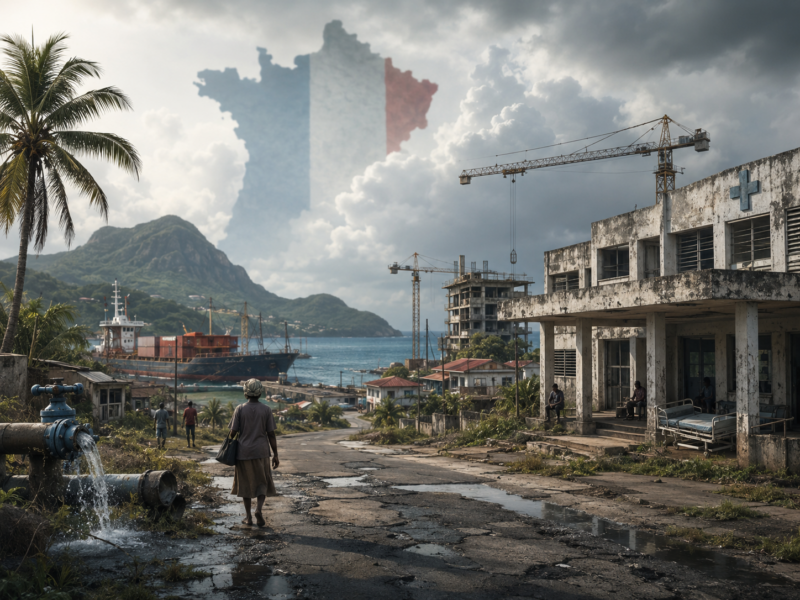
The consequences of this decline in public investment extend far beyond the economic sphere alone. Today, they are fueling all of the social challenges facing Guadeloupe and Martinique. Structural unemployment remains among the highest in France, particularly among young people. The exodus of college graduates continues, gradually depriving these territories of part of their human capital. The challenges in managing Sargassum, the water crisis in Guadeloupe, significant security tensions, the aging of public infrastructure, delays in hospital facilities—particularly in Martinique—and the weakness of local production all stem, to varying degrees, from a persistent lack of public investment and the absence of a genuine long-term development strategy.
In this context, the recurring debates on institutional changes toward greater autonomy appear to many as a way to shift the center of gravity of political responsibilities. There is a significant risk that the state will gradually transfer more powers along with autonomy without simultaneously transferring the financial resources essential to exercising them. Autonomy without new resources would not provide a solution to economic difficulties; on the contrary, it could lead to the institutionalization of budget shortfalls and place the sole responsibility for a situation—largely inherited from decisions made at the national level—on local governments. In this sense, the desire for control expressed by elected officials who support local tax autonomy may prove to be a mirage, given the reform of the dock dues tax planned for 2027.
This question is all the more legitimate given that the root causes of the economic decline in the Antilles stem largely from national public policies. For decades, the development model has been based on consumption, social transfers, and public investment. While this model is now showing its limitations, its transformation cannot rest exclusively on local governments, whose financial leeway remains extremely limited. The primary responsibility lies with the national government, which designed this model, financed it for several decades, and then gradually reduced its funding without establishing a new development framework.
The urgent need, therefore, is not merely to maintain existing measures, but to propose a new economic vision for the French Antilles. This vision should take the form of a genuine industrialization plan based on the comparative advantages of Guadeloupe and Martinique, by leveraging the agri-food sector, tropical biotechnology, renewable energy, the digital economy, processing industries, the maritime economy—including the major Guadeloupe/Martinique Hub—applied research, and high-value-added logistics services. The goal would be to create sustainable, skilled jobs, reduce dependence on imports, strengthen local economic sovereignty, and simultaneously combat unemployment and the high cost of living.
Such a strategy would require a massive commitment from the government, comparable to the one it mobilizes to support major industrial transitions within mainland France. The French West Indies cannot be confined indefinitely to a model of social compensation when they possess considerable geographic, human, and strategic assets at the heart of the Caribbean. The real challenge now is to shift from a policy of redress to one of production, competitiveness, and investment.
The issue is therefore no longer just a budgetary one; it is deeply political.
To understand the current situation, it is essential to look back at the evolution of public policies implemented by the government since the early 2000s. In the decades following the 1946 departmentalization, Guadeloupe and Martinique benefited from significant public investment aimed at closing the gap in infrastructure, public services, education, and healthcare. This convergence policy led to a dramatic improvement in the standard of living, but it also shaped an economic model heavily dependent on public spending. Beginning in the 2000s, and then more markedly after the 2008 financial crisis, the government’s budgetary priorities gradually shifted. Driven by efforts to control public deficits and by rising needs in other overseas territories—notably French Guiana, which faces a significant infrastructure deficit as well as strong population growth, and Mayotte, which is engaged in a massive effort to catch up on its public infrastructure, and the eradication of extreme poverty, the French Antilles have seen their relative weight in national budgetary decisions diminish and have been literally shortchanged.
This reallocation of resources to the detriment of Guadeloupe and Martinique has resulted in a slowdown in infrastructure investment, a reduction in certain tax-exemption programs, a diminished capacity to finance major development projects, and a gradual loss of economic momentum. However, in economies where public investment accounts for nearly two-thirds of total investment, any sustained contraction in public spending produces negative multiplier effects across the entire economy: a decline in construction, fewer orders for local businesses, a slowdown in job growth, a decline in private investment, and a weakening of consumer spending. This well-documented economic mechanism partly explains why the difficulties currently faced in Guadeloupe and Martinique cannot be attributed solely to local management failures. They are also the result of strategic decisions made at the national level that have gradually deprived these territories of the levers essential to their development.
The paradox is that, at the same time, the government continues to assert its commitment to promoting territorial cohesion while gradually dismantling the very tools that made it possible to achieve that cohesion. This contradiction fuels a growing sense of abandonment among the people of the French West Indies. It also fuels mistrust of institutions and encourages fruitless debates over changes in status, while the fundamental issue remains that of the national economic strategy dedicated to the French West Indies. Before changing the institutions, it would first be necessary to rebuild the economic foundations capable of guaranteeing the creation of wealth, jobs, and tax revenue. Without this preliminary reconstruction, any institutional reform risks having no effect on the daily hardships faced by the people of Guadeloupe and Martinique.
The government cannot continue to cite public finance constraints to justify a gradual withdrawal while allowing economic and social divides to widen. While local governments bear a significant share of the responsibility for implementing public policies, they lack both the financial capacity and the macroeconomic levers necessary to reverse several decades of relative decline on their own. Ultimately, the government’s responsibility remains central to the current trajectory of Guadeloupe and Martinique. Ceasing to shift the burden of these challenges onto local elected officials—by accusing them of incompetence or pointing to a hypothetical change in status—is now an essential prerequisite for rebuilding a genuine development plan. It is through a renewed commitment, an ambitious investment policy, and a major industrialization plan that the growing impoverishment of the Caribbean population can be halted and a sustainable path toward economic prosperity and social cohesion can be restored.
The urgency of a new strategy is all the more evident given that the former drivers of growth in Guadeloupe and Martinique have now been permanently weakened. The sugar industry, long a mainstay of the Caribbean economy, is undergoing a profound crisis. The hospitality sector, facing increased international competition, high operating costs, and insufficient investment, no longer plays the leading role it once did.
As for construction and public works—traditionally the driving force behind economic activity thanks to public contracts—this sector is suffering directly from the decline in investment by local governments and the central government. The simultaneous erosion of these three historic pillars means that the French Antilles have reached the end of an economic cycle. Consequently, the focus is no longer on trying to revive a model that is losing momentum, but on building a new one. Just as with the large-scale programs for reindustrialization, ecological transition, and energy sovereignty underway in mainland France, the government must make an exceptional financial commitment to support Guadeloupe and Martinique.
Only a policy of massive investment in the industrial sectors of the future, innovation, infrastructure, the energy transition, and new artificial intelligence technologies will make it possible to create productive jobs, restore regional competitiveness, and usher in a new phase of sustainable economic development.
Jean Marie Nol, economist and lawyer