




PFV No. 71:
May 27, 2020
PROHIBITION ON MIXED-GENDER CLASSES
While churches are open to everyone—Christians and non-Christians, men and women—Islam provides for exceptions in these areas.
Mosques Off-Limits to Non-Muslims
Mecca, Islam's holiest site located in Saudi Arabia, is a territory haram(forbidden) to non-Muslims. Only those who recite the chahada(Islamic creed).
- O you who believe! The polytheists [or unbelievers] are nothing but impurity; therefore, they shall no longer approach the Sacred Mosque after this year has passed.(9, 28).
The Quran extends this prohibition to all mosques.
- Only the following will frequent the mosques of Allah: those who believe in Allah and the Last Day; those who perform the prayer; those who give charity; and those who fear none but Allah (9, 18).
This rule has been adopted by certain traditional Sunni schools of law in countries that draw upon them to shape their own legal systems. This is particularly the case on the Arabian Peninsula and in Morocco (with the exception of the Hassan II Mosque in Casablanca, outside of prayer times). But almost everywhere else, non-Muslims are permitted to visit, with some exceptions and under certain conditions.
It should also be noted that in some countries (Iran, in particular), police officers prevent Muslims from entering churches so that they cannot attend Mass.
The Marginalization of Women
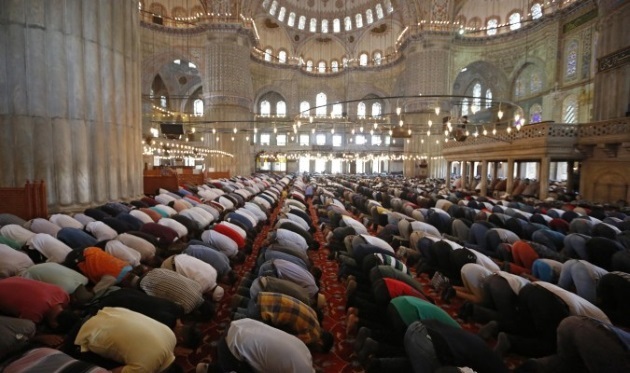
Muslim women who wish to pray at the mosque are never encouraged to do so; in fact, they are barred from entering at certain times in their lives when they are considered ritually impure (after childbirth, during menstruation; see Quran 2:222). « A woman is subject to a periodic incapacity caused by her menstrual cycle: since she is in a state of impurity during her period, she must therefore refrain from certain religious practices. Thus, she must refrain from daily prayers and fasting; she may neither touch nor read the Quran; she must not enter a mosque or perform the tawhâf (circling) around the Kaaba [a practice associated with the pilgrimage to Mecca]. These instructions are not found in the Quran but in the Hadith [a collection of sayings attributed to Muhammad] and are specified in the law […]. These precepts are strictly observed throughout the Muslim world today, just as they were in the past » (Viviane Liati, On the Use of the Quran, published by Mille et une nuits, 2004, p. 245).
Ritual purity is a prerequisite for the validity of prayer. This is also true for a man who has previously had physical contact with a woman.
If women wish to attend the mosque, a closed-off area, separated by a curtain, or a special room, is reserved for them. Admittedly, until fairly recently, it was common to see Catholic men and women seated on opposite sides of the nave in churches to attend Mass, but the women were not hidden from the men’s view. As for the concept of impurity, the Church, following Christ, has stripped it of its legal or ritual character, retaining only its moral aspect (cf. Mark 7:18–23).
The rule against mixing of the sexes applies when leaving the mosque, according to a recommendation attributed to Muhammad. « All legal scholars, both Sunni and Shia, advise against it—that ismakrûh (detestable) – the mixing of men and women » (Anne-Marie Delcambre, Islam and Its Prohibitions, Desclée de Brouwer, 2003, pp. 40–41). It is also practiced during celebrations and wedding receptions.
CONQUEST THROUGH THE MOSQUE
While the mosque is certainly a place of Muslim worship, it also serves an ideological agenda. This agenda seeks to establish Islam as the sole religion, particularly in traditionally Christian regions, since the Quran considers the Gospel to be a falsified doctrine and aims to impose itself on the entire world.
Several historical and contemporary events provide concrete examples of this ambition and the dynamics of power it entails.
Churches That Have Been Plundered or Mocked
According to a widely accepted principle, any place where Muslim prayer has been performed becomes ipso de facto «Land of Islam.».
During the early conquests in the Levant, the Muslims seized churches and converted them into mosques (see. PFV No. 70). In Lebanon, at least two mosques are former churches—one in Beirut and the other in Tripoli.
Under the dhimmitude system, codified in the 11th century by the Mesopotamian jurist Ali Mawardi, Christians were no longer permitted to ring the bells of their churches or to build new ones (see A. Laurent, Islam, Artège, 2007, pp. 93–94; and Will Eastern Christians Disappear?, Salvator, 2007, pp. 97–110). In the 20th century, the decolonization of the Maghreb was accompanied by the conversion of churches into mosques.
« The minarets are our bayonets, the domes our barracks, and the believers our soldiers ». This verse by the Turkish poet Ziya Gökalp (1875–1924), who was banned by Atatürk, was recited in public by Recep Tayyip Erdogan in 1998 in Istanbul, where he was then mayor, an act that led to his removal from office and a four-month prison sentence for « incitement to religious hatred » (A. Laurent, Europe’s Aversion to Turkey, F.-X. de Guibert, 2005, p. 89).
In 2018, after becoming president of Turkey, Erdogan recited a verse from the Quran in the former Hagia Sophia, declaring, the following year, his intention to restore it to the status of a mosque that it had held from the Islamic conquest of Constantinople (1453) until Atatürk converted it into a museum (1934).
In Egypt, before Marshal Abdelfattah El-Sissi took power (2013), when Christians obtained permits to build a church, it was not uncommon for Muslims, once the administration’s decision became known, to rush to buy the lot adjacent to the construction site in order to build a mosque there, thereby depriving the church in question of its right, in the name of Islam’s primacy.
In Lebanon, after the war (1975–1990), former Prime Minister Rafic Hariri, who was in charge of rebuilding downtown Beirut, had a massive mosque built there with four tall minarets, the sheer size of which dwarfs the neighboring cathedral, St. George’s Maronite Cathedral. The El-Amine Mosque was inaugurated in 2003. In response, the Maronite archdiocese had a bell tower with bells and a cross at its top added to its cathedral.
In the Name of the Right to Freedom of Worship
Today, as Islam takes root outside its traditional territories—regardless of the means used to achieve this (jihad, emigration, birth rates, demands for rights in the name of the host countries« values, instilling guilt in Westerners, etc.), one of its priorities is to increase the construction of mosques. However, nothing prevents Muslims from performing their ritual prayers in unmarked or non-dedicated places—even a simple room—or outdoors, since, according to the Sunnah (Tradition), Muhammad is said to have stated: “ Whenever the time for prayer comes, you must pray, and this is a »masjid [mosque]." However, the purpose of these street prayers is to pressure the authorities into granting the necessary permits.
In his latest book, Mohamed Sifaoui, a lecturer at the Sorbonne, recounts an event that took place at the Ministry of the Interior in 1999, at a time when Jean-Pierre Chevènement, then head of the ministry, was negotiating with various Muslim partners to establish a French Islam. During a break, several members of the Union of Islamic Organizations of France, a satellite organization of the Muslim Brotherhood, took off their shoes in a hallway to perform a prayer lasting about ten minutes, under the astonished gaze of an advisor who tried to dissuade them on the grounds that it violated the principle of secularism. « The unease is palpable, but no one says anything, and the meeting resumes », notes Sifaoui (Taqiyya, published by Éditions de l’Observatoire, 2019, pp. 326–327).
Furthermore, the mosque is not politically neutral. « We must not be fooled. Every time a mosque is built, the government that funds it has a say in who preaches there and what they tell the worshippers. », notes Alain Cabras, associate professor at Sciences Po Aix-en-Provence (Current Values, May 15, 2014). As for Catholics’ relations with the Holy See, whatever form they may take—including material assistance—they do not imply any ideological choice.
Minarets, the Call to Prayer, and the Call to War
In recent years, in the West, concerns have centered on public calls to prayer (adhan), a function reserved for the muezzin («the one who calls»). To justify its use, citing the principle of equal treatment of religions, Muslims point to the permission granted to Catholics to ring church bells. However, unlike church bells, the muezzin delivers an explicit doctrinal message that is binding on everyone, Muslim or not.
- Allah is the greatest. I bear witness that there is no god but Allah. I bear witness that Muhammad is the Messenger of Allah. Hurry toward fulfillment; Allah is the greatest.
Generally speaking, the call to prayer is made from the top of the minaret (from the Arabic manâra = minaret), a tower that can take on various architectural forms depending on the culture and country. Some mosques have up to four minarets, which are sometimes very tall. The sound of the call to prayer, amplified in neighborhoods or villages with multiple mosques, gives it the role of a symbolic presence and can constitute a disturbance of public order; it can also interfere with prayer and the celebration of Mass in parishes or monasteries when a mosque is located nearby, or when the Friday sermon—which can last an hour—overlaps with Christian religious services.
« Historically, the expression [« Allah akbar » = Allah is the greatest] has also become a battle cry », notes Islam scholar Pierre Lory. It was already in use during the time of Muhammad, who is said to have employed it during the victorious Battle of Badr in 624, fought against his fellow Meccans who had forced him into exile in Medina. However, strict imitation of Muhammad—« including his role as a warlord, who led military campaigns, took hostages, and executed prisoners »—is now the common thread linking the various strands of radical Islamism. P. Lory wonders about the motives that drive jihadists to chant this phrase when it accompanies their acts of violence: « Is the purpose to bless their action, to give it meaning, or to ward off danger? » (La Croix, December 23, 2014).
IN CONCLUSION
The examples cited here show that, in Islam, religious worship is inseparable from an ideological dimension.
Sami Kab, a Palestinian writer, a Muslim by birth who has embraced agnosticism and spends time with Christians in the Holy Land, drew the following lessons from his experience based on his comparison of the culture of the mosque with that of the church. « The mosque teaches Muslims resentment and hatred toward others; it incites murder, authoritarianism, the marginalization of non-Muslims, and the glorification of nothingness at the expense of life. Such teachings lead only to human misery and the poisoning of one’s existence. […]. The mosque forbids man from thinking, for it is an act of disbelief, atheism, and an insult to Allah. It compels him to accept and believe that Allah, the All-Knowing, has already revealed all the knowledge of the world inthe Quran […]. The mosque preaches resignation, total submission, servitude, and the stripping of the human personality of everything it embodies in terms of the values of independence and freedom. It transforms society into a herd that blindly carries out the orders of the wali (judge) […]. It leaves no room for the free flow of human thought, since its own thought consists entirely of duties, imperatives, obligations, and prohibitions. With its rigid mindset, Islam derives its sacredness from its immobility and its inability to change, development, modernization, and the demands of life. Islam sanctifies its god at the expense of humankind, whereas Christianity sanctifies humankind as a creation of its god. In other words, the Christian God exists for humankind, whereas in Islam, humankind exists for God. Christianity embodies the religion of life, while Islam embodies that of death and nothingness. » («The Disastrous Culture of the Mosque,» in Maurice Saliba, Islam Exposed by Its Own People, Riposte laïque, 2019, pp. 166–168