


Close Menu
ANTILLA MARTINIQUE | Avec vous depuis 1981

    Subscribe

    Get the latest creative news from ANTILLA on art, design, and business

    Current Trends

    Sainte-Lucie- Face à la chaleur et à d’autres pressions qui mettent l’agriculture à rude épreuve, les agriculteurs explorent de nouvelles approches.

    August 15, 2026

    Transports : l’unité et la responsabilité pour réussir la rentrée scolaire

    August 14, 2026

    BBS (LA MAUNY/TROIS-RIVIÈRES) : derrière la reprise par Les Bienheureux, un lourd défi industriel et financier

    August 14, 2026
    Facebook X (Twitter) Instagram
    ANTILLA MARTINIQUE | Avec vous depuis 1981ANTILLA MARTINIQUE | Avec vous depuis 1981
    • Sections
      • Editorial by Henri PIED
      • Ecology / Environment
      • Art/Culture
      • Caribbean
      • Companies
      • Gdc's Perspective
      • Heritage
      • Politics
      • Health
      • Sports
      • Opinion Pieces
    • Our Files
      • Great Figures
        • Édouard Glissant
        • Aimé Césaire
        • Frantz Fanon
        • Pierre Aliker
        • Camille Darsières
        • Alfred Marie-Jeanne
        • Patrick Chamoiseau
        • Raphaël Confiant
        • Serge Letchimy
      • Key Issues
        • Sargassum
        • Rum
        • High Cost of Living
        • The Press in Martinique
      • Profile or Investigation
    • About
      • About Us
      • Media Kit
    • Contact
    • Change language to Français
    annonces
    SUBSCRIPTION
    ANTILLA MARTINIQUE | Avec vous depuis 1981
    Home » The Martinique Paradox of 2026 Article 4 Chlordecone, Sargassum: When Environmental Factors Limit the CTM’s Room for Maneuver
    Opinion Pieces

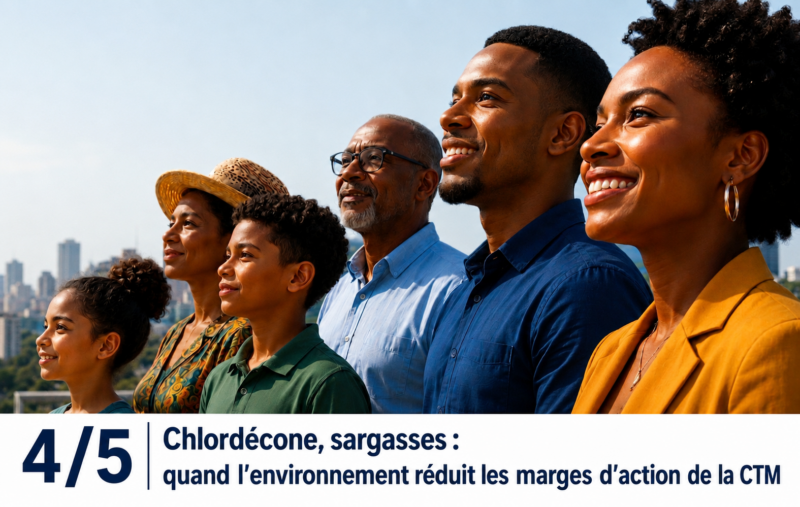
    The Martinique Paradox of 2026 Article 4 Chlordecone, Sargassum: When Environmental Factors Limit the CTM’s Room for Maneuver

    July 29, 2026Updated:July 29, 2026No Comments
    Facebook LinkedIn WhatsApp


    After analyzing the institutional, financial, and demographic constraints that currently limit public action in Martinique, another factor emerges as equally decisive: the environment. The Martinique paradox does not stem solely from the organization of government or insufficient budgetary resources. It is also explained by the accumulation of ecological crises that place a sustained strain on public finances, reduce the territory’s productive capacity, and limit the room for maneuver of the Territorial Collectivity of Martinique. Ten years after the creation of the CTM, chlordecone and Sargassum seaweed illustrate this reality: a local government is investing an increasing share of its resources not to prepare for the future, but to manage the consequences of past or recurring crises.

    A community with no safety net in the face of crises

    The CTM’s limited self-financing capacity reduces its ability to absorb external shocks. Social spending, rising debt, and ongoing infrastructure needs severely limit its investment capacity. Each new environmental crisis thus diverts resources that could otherwise be devoted to development.

    Chlordecone: Long-Term Pollution

    Although its use ceased in 1993, chlordecone continues to have a lasting impact on soil, waterways, and certain agricultural activities. Successive plans have allocated significant funding for research, health monitoring, and support for farmers, while also highlighting the ongoing cost of this pollution.

    Food Sovereignty and Dependence

    Soil contamination reduces certain local production capacities and perpetuates dependence on imports. This situation exacerbates supply difficulties and indirectly contributes to the high cost of living.

    Sargassum: A Recurring Crisis

    Shipwrecks result in significant costs for recovery, transportation, and disposal. Health hazards, the negative impact on tourism, and the challenges faced by coastal municipalities place a lasting burden on Martinique’s economy.

    Constraints that pile up

    Demographic, financial, environmental, and economic constraints reinforce one another and are gradually reducing the community’s capacity to act.


    The Martinican paradox is strikingly evident: the CTM is devoting an increasing share of its resources to managing long-standing or recurring environmental crises, at the expense of investments that would lay the groundwork for the territory’s sustainable future.

    Mikaël Glondu-Monnerville. 

    Related Posts

    «What if the real change were a shift in Martinican political culture?» By Franck A

    August 11, 2026

    BACCHA FESTIVAL: A Resounding Success—When the Facts Speak for Themselves!

    August 10, 2026

    French West Indies: Is “Europeanization” the New Horizon?

    August 10, 2026
    Add A Comment

    Comments are closed.

    DISPONIBLE EN KIOSQUE
    Caribbean News
    Caribbean

    Sainte-Lucie- Face à la chaleur et à d’autres pressions qui mettent l’agriculture à rude épreuve, les agriculteurs explorent de nouvelles approches.

    St Lucia Times ParKeryn Nelson À l’issue de deux symposiums agricoles organisés à Dennery et Union, près de Castries, les agriculteurs et autres acteurs du…

    « Que représente la CARICOM pour la jeunesse ? » : La jeunesse caribéenne répond

    August 14, 2026

    Les centres de formation technique et professionnelle de Sainte-Lucie se font l’écho de l’appel régional aux compétences

    August 14, 2026

    Saint Lucia Officially Launches a 1,000 EC$ Allowance for Newborns

    August 4, 2026

    OECO delegates review Sargassum management strategies following their mission to French territories

    August 2, 2026
    SUBSCRIBE TO OUR CHANNEL!
    Post Your Legal Notices

    Subscribe

    Get the latest news from Antilla Martinique.

    Thank you! Your request has been received.

    View legal notices
    View our back issues
    Our Different Sections
    Archives
    © 2026 Copyright ANTILLA. All rights reserved. Programmed by ANTILLA.
    • CONTACT
    • MARKETING
    • LEGAL NOTICE
    • LEGAL NOTICES
    • ABOUT ANTILLA

    Type above and press Enter to search. Press Esc to cancel.