




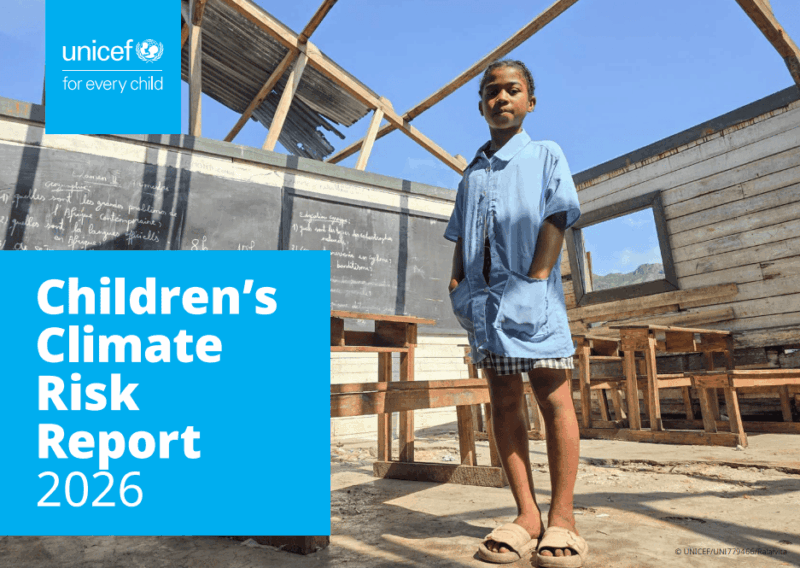
When we talk about climate change, the images that spontaneously come to mind are often those of hurricanes, floods, or wildfires. Less often, they include images of a classroom closed after a storm, a health clinic without electricity, or a child forced to interrupt their education because access to water or healthcare has been disrupted.
Yet it is precisely this reality that the new [...], 2026 Report on Climate Risks to Children published by UNICEF. The UN agency has issued an alarming report: 1.1 billion children—nearly half of the world’s children—are now exposed to at least three simultaneous climate hazards. More broadly speaking, virtually all children around the world today face at least one major climate-related threat.
For island territories, including France’s overseas territories, the warning is particularly stark: UNICEF reports that All children in overseas territories are at risk from severe tropical storms.
A climate crisis that is also becoming a crisis of children’s rights
The UNICEF report goes beyond environmental observations. It now considers climate change to be a crisis in children's rights.
The consequences of climate-related hazards are not limited to property damage or economic losses. They directly affect essential aspects of children’s lives: their health, nutrition, access to safe drinking water, education, safety, and psychological well-being.
Heat waves increase the risk of heatstroke and dehydration. Droughts exacerbate food and nutritional insecurity. Floods and storms can displace entire families, disrupt the education of thousands of children, and cause long-term disruption to public services.
«Children's lives continue to be disrupted by heat waves, wildfires, droughts, and floods,», sums up Catherine Russell, Executive Director of UNICEF.
This vulnerability is also linked to the very nature of childhood. Because children’s bodies are still developing, they are more exposed to the physical and psychological consequences of extreme events. They also have fewer coping mechanisms when faced with disruptions to their daily lives.
Island Territories on the Front Lines
The report highlights another reality that is often less visible: not all regions are equally vulnerable to the climate crisis.
Islands are among the most vulnerable areas. Their geographic layout and their dependence on infrastructure that is sometimes concentrated within small areas make the consequences of extreme events particularly difficult to manage.
A tropical storm is never just a meteorological phenomenon. In an island territory, it can simultaneously cause power outages, water supply problems, disruptions to transportation networks, school closures, and strain on healthcare systems.
UNICEF also points out that small island developing states face specific vulnerabilities related, in particular, to their small size, geographic isolation, limited resources, and high exposure to external shocks.
The report points out that tropical storms can sometimes «to paralyze entire islands all at once and overwhelm essential services.».
A vulnerability that directly affects the overseas territories
France’s overseas territories are no exception to this reality. The report indicates that all children living in these territories are at risk from severe tropical storms.
UNICEF also highlights another aspect of the problem: the adaptability and resilience of regions may be limited when certain essential services remain under-resourced or face significant structural constraints.
The examples cited in the report illustrate this vulnerability. In French Guiana, droughts and river flooding regularly disrupt access to schools and health care. In Mayotte, the passage of Cyclone CHIDO highlighted the particular vulnerability of certain territories to increasingly severe weather events.
These situations serve as a reminder that climate vulnerability is not limited to exposure to natural hazards alone. It also depends on societies’ ability to maintain essential services when a crisis strikes.
Thinking About Adaptation from a Child's Perspective
One of the report’s key lessons is precisely this: climate adaptation can no longer be viewed solely through the lens of infrastructure or environmental policies.
It also involves examining how local communities actually protect their children.
For UNICEF, this involves, in particular, developing safer and more environmentally friendly schools, strengthening the resilience of health infrastructure, securing water supply networks, establishing early warning systems accessible to the public, and developing social protection mechanisms capable of responding to climate-related shocks.
The organization also calls for greater involvement of children and young people in climate policy by investing more in education, knowledge, and skills related to the ecological transition.
«In France, all children across our territories are exposed to the impacts of climate change. Faced with the increasing frequency and intensity of extreme weather events, we must urgently strengthen the resilience of our critical systems and invest in adapting our most vulnerable regions—particularly in the overseas territories—to protect our children and their future starting now,» said Adeline Hazan, president of UNICEF France.
Ultimately, the UNICEF report highlights a self-evident truth that is sometimes overshadowed by debates on carbon emissions or global warming trajectories: the climate crisis is also measured by a society’s ability to protect its children when extreme events occur. And in island regions, where a single storm can simultaneously strain all essential infrastructure, this issue has already become a major challenge for social cohesion and intergenerational solidarity.
View the full report by following this link: https://data.unicef.org/resources/childrens-climate-risk-report-2026/