




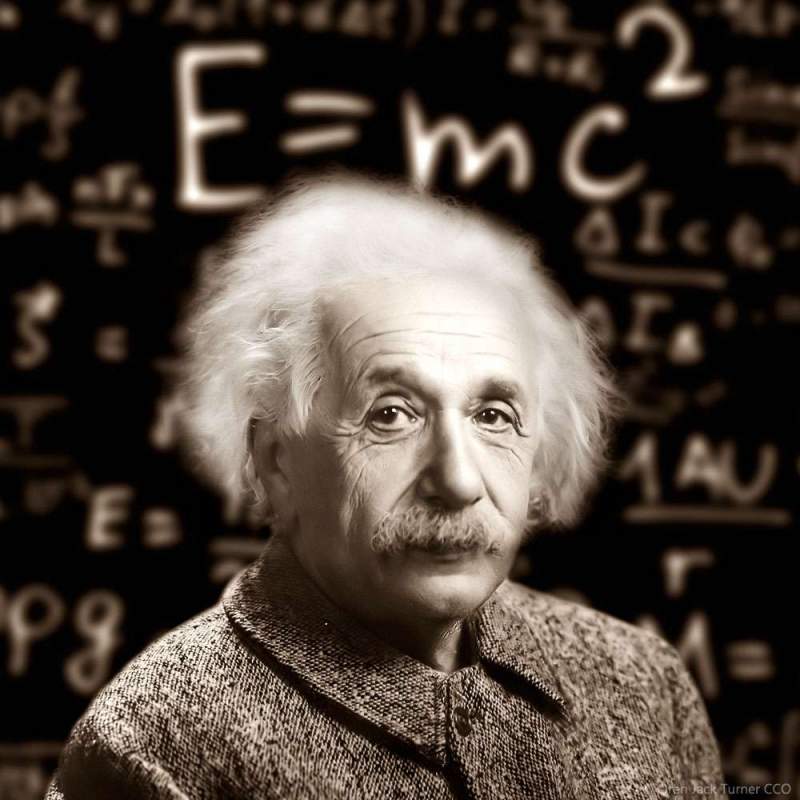
Einstein's Two Mistakes
Scientific research is based on the correspondence between the reality of nature—which is understood through observations—and a representation of that reality—formulated by a theory in mathematical language. If all the consequences that follow from the theory are experimentally verified, the theory is validated. This approach, followed for nearly four centuries, has built a coherent body of knowledge. But these advances are made possible by human intelligence, which nevertheless retains its beliefs and even its biases. This can affect the progress of science even among the greatest scholars.
The First Mistake
In his magnum opus, *General Relativity*, Einstein wrote the equation describing the evolution of the universe over time. The solution to this equation points to an unstable universe: the universe is not a large sphere of constant volume over which the stars glide, as was believed at the time.
At the beginning of the 20th century, everyone held the deeply ingrained belief in a static universe where the movements of the celestial bodies repeated themselves endlessly. This was likely a consequence of Aristotle’s teachings: the firmament is immutable, unlike the perishable Earth. This led to a historical anomaly: while in the year 1054 the Chinese recorded the appearance of a new light in the sky, no European document mentions it. And yet it was visible in broad daylight and lasted several weeks. It was a supernova—that is, the end of a star—the remnants of which form the Crab Nebula, still visible today. The prevailing mindset in Europe prevented people from accepting a phenomenon so at odds with the idea of an unchanging sky. A supernova is a very rare event; one is visible to the naked eye about once a century, with the last one dating back to 1987—Aristotle was almost right to think the heavens were unchanging, at least on the scale of a human lifetime.
The Crab Nebula, observed today across various wavelengths, was not recorded by Europeans when it first appeared in 1054. Torres997/Wikimedia, radio image: NRAO/AUI and M. Bietenholz, J.M. Uson, T.J. Cornwell; infrared: NASA/JPL-Caltech/R. Gehrz, University of Minnesota; visible light: NASA, ESA, J. Hester and A. Loll, Arizona State University; ultraviolet: NASA/Swift/E. Hoversten, PSU; X-rays: NASA/CXC/SAO/F. Seward et al.; gamma rays: NASA/DOE/Fermi LAT/R. Buehler, CC BY-SA
To remain consistent with a static universe, Einstein introduced a cosmological constant into his equations that «froze» the state of the universe. A lack of intuition: when Hubble demonstrated in 1929 that the universe was expanding, Einstein admitted to having made “his biggest mistake.”.
Quantum Randomness
Alongside relativity, quantum mechanics developed, which describes the physics of the infinitely small. Einstein made a major contribution to this field by interpreting the photoelectric effect as early as 1905 as a collision between electrons and photons—that is, infinitesimal particles of energy. In other words, light—which is traditionally described as a wave—behaves like a stream of particles. It was this breakthrough, and not the theory of relativity, that earned Einstein the Nobel Prize in 1921.
But despite this essential contribution, he stubbornly refused to accept the key lesson of quantum mechanics: the world of particles is not subject to the strict determinism of classical physics. The quantum world is probabilistic: we can only predict the probability of an outcome occurring among a set of possibilities.
In Einstein’s blindness, we can once again point to the influence of Greek philosophy: Plato taught that thought must remain ideal, free from the contingencies of reality. A noble idea, but one that does not follow the precepts of science—knowledge requires perfect agreement with all predicted facts, whereas belief is based on plausibility, the result of partial observations. Einstein himself was convinced that pure thought is capable of grasping all of reality, yet quantum randomness contradicts this hypothesis.
In practice, this randomness is not arbitrary; it is constrained by Heisenberg’s uncertainty principle, which imposes collective determinism on populations of particles: an electron is individually free since we cannot calculate its trajectory as it emerges from a hole, but a million electrons produce a diffraction pattern showing dark and bright fringes that we can calculate.
Result of an experiment involving so-called «Young’s» interference: the pattern forms as electrons arrive: 8 electrons in photo a, 270 in photo b, 2,000 in photo c, and 60,000 in photo d, ultimately forming vertical bands called interference fringes. Dr. Tonomura/Wikimedia, CC BY-SA
Einstein refused to accept this fundamental indeterminism, which he summed up in a provocative statement: «I refuse to believe in a God who plays dice with the world.» ” He posited the existence of hidden variables—that is, quantities yet to be discovered beyond mass, charge, and spin, which physicists use to describe particles. But experiments did not support his view. We must accept the existence of a reality that transcends our understanding: we cannot know everything about the infinitely small world.
The Whims of the Imagination
Albert Einstein sticks out his tongue on his 72nd birthday. Arthur Sasse/AFP
In the scientific process, there remains one step that is not entirely objective: the one that leads to the conceptualization of a theory. Einstein, with his thought experiments, provides an illustrious example of this. He himself stated: «Imagination is more important than knowledge.» ” Indeed, a physicist must, based on disparate observations, imagine an underlying law. Sometimes several theoretical models are proposed from which a choice must be made; it is only at this stage that logic regains control.
«Intelligence has nothing to discover; it has to clear the way. It is good for nothing but menial tasks.» (Simone Weil, «Gravity and Grace»)
Thus, the advancement of ideas depends on what is called intuition. It is a kind of leap in knowledge that goes beyond pure rationality. The boundary between the objective and the subjective is no longer completely watertight. Thoughts originate at the level of neurons under the influence of electromagnetic impulses, and among them, some are particularly fruitful—as if a short circuit were occurring between cells—with chance at the helm.
But these «flowers» of the human mind—these intuitions—are not the same in Einstein’s brain as they are in Proust’s. One will give rise to E=mc², and the other to a wonderful metaphor. Intuition strikes at random, but this randomness is shaped by each person’s experience, culture, and knowledge.
The Benefits of Chance
The fact that there is a reality beyond our intellect alone should not come as a surprise to us. Without chance, we are driven by our instincts, our habits, and everything that makes us predictable. Our actions are confined almost exclusively to this first level of reality, with its ordinary concerns and obligatory tasks. But there is another level, one marked by apparent randomness.
«No administrative or academic effort will ever replace the miracles of chance to which we owe our great men.» (Honoré de Balzac, «Cousin Pons»)
Einstein is a model of an inventive and free spirit, and yet he clings to his prejudices. His «first mistake» can be summed up as «I refuse to believe in a beginning to the universe.» Yet experience proved him wrong. His verdict on God rolling the dice is: «I refuse to believe in chance.» Yet quantum mechanics implies inherent randomness. One might even wonder whether he would believe in God in a world without chance, which would greatly diminish our freedom since we would then be confined to absolute determinism. Einstein persists in his refusal because, for him, the human brain must be capable of knowing what the universe is. Much more modestly, Heisenberg responds: physics is limited to describing how nature reacts under defined circumstances.
Quantum theory shows that we cannot fully understand it. In return, it offers us chance—with its frustrations and dangers, but also its benefits.
«Man escapes the laws of this world only for the duration of a flash of lightning. Moments of stillness, of contemplation, of pure intuition… it is through these moments that he is capable of the supernatural.» (Simone Weil, «Gravity and Grace»)
The legendary physicist is the quintessential example of an imaginative person. His rejection of chance is therefore a paradox, since it is chance that makes intuition possible—the spark that ignites the creative process.