




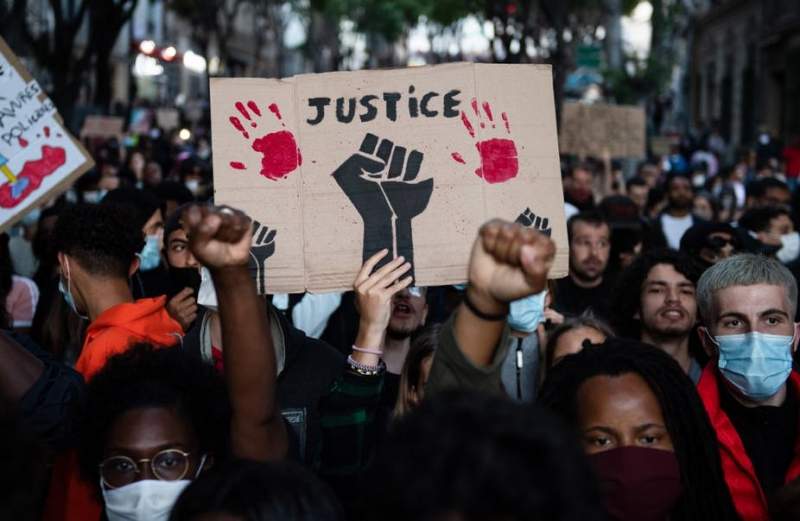
The issue of discrimination against ethnic minorities made headlines in early summer 2020, particularly during the incident George Floyd in the United States and the impact it may have had in countries such as France, where the Traoré case has fueled protests and demands led by anti-racist organizations.
In France, we can no longer afford to treat this issue as a mere epiphenomenon or reduce it to the expression of far-left radicalism seeking to reinvent itself by championing «people of color» « in order to distinguish itself from a »bureaucratic” left-wing government that has allegedly neglected social issues in favor of economic considerations alone.
In fact, it resonates with an issue that the COVID-19 crisis itself has brought to light, namely that of social cohesion in France and the rationale behind the living together.
A Debate on Principles
The debate over ethnic discrimination has become heated in France for several reasons.
First of all, because a country like France, which proudly proclaims its commitment to republican equality, has come to be viewed—rightly or wrongly—as racist practices particularly within law enforcement agencies, which suggests that there is a wide gap between the articulation of broad principles and the reality on the ground.
The theme of the everyday racism, or even «systemic», adds fuel to a critical discourse that is unfolding in many other areas.

For example, violence against women, educational inequalities, the deterioration of public services, and the impoverishment of the middle class have led to criticism of a persistent disconnect between the social realities observed on the ground and the official rhetoric of «benevolence» and solidarity espoused by successive governments for decades.
It is at the heart of this disconnect that we might find the deep-rooted causes of the distrust of politics and representative democracy that characterizes France more than any other country in Europe.
A contrast between two interpretations of progress
Second, for more purely political reasons, because the issue of racism is driving a wedge within the left, pitting the republican and secular left against a left that advocates for the right to diversity of communities and cultures. This isn't just a local squabble.
Behind this conflict lie two opposing interpretations of progress, even though both factions of the left strongly condemn racism: on the one hand, the advancement of the poorest through social justice and education, regardless of background; on the other, the inclusion of cultures and religions in open integration policies.
It is the contrast between the republican vision of a unified and neutralized public sphere and the democratic vision of a communal mosaic held together by respect for a shared moral law rooted in respect for differences. But it is also the contrast between, on the one hand, a proactive project of emancipation—still a work in progress—and, on the other, the idea of critically assessing a history that has allegedly neglected discrimination to a great extent.
Finally, the fact remains that this issue is not easy to address from the perspective of social science research.
The objective and the subjective overlap
We are dealing here with an area where objective data are difficult to apply. Racial discrimination cannot be reduced to a simplistic econometric framework in which everything is explained by the unemployment rate or the standard of living. It involves subjective perceptions and a sense of unease on the part of those who suffer from the relationships they maintain or endure with others. This is a field where the objective and the subjective overlap.
The Ban The inclusion of ethnic statistics in surveys also provides a beautiful illustration The problem is this: on the one hand, it can quite rightly be argued that they serve no purpose, since data is already available on the geographic or national origins of the respondents or their families.
Furthermore, it is very difficult to categorize people by race or origin without falling into the kind of essentialization that is precisely what defines racism: What is a «Black» person, a «White» person, or an «Asian» person?
What do we do about people of mixed race? Should we create color charts? What about grandparents? Furthermore, is a wealthy Black or White person comparable to a poor Black or White person?
This debate is effectively portrayed in Peter Farrelly's film Green Book: On the Roads of the South in which Tony Lip, an Italian-American bouncer from the Bronx, is hired to accompany Dr. Don Shirley, an internationally renowned Black pianist, on tour. The former says to the latter, «But I’m much blacker than you are! I’ve lived in the Bronx, and I know what poverty is like!» And the latter replies, «Yes, but I still feel different when people look at me!»
In fact, the argument put forward by advocates of ethnic statistics is also very accurate : We don't objectively belong to a particular race or ethnicity, but we feel that we belong to a different race or ethnicity based on how others view us.
It is a process of both personal and social self-identification through which one establishes a sense of distance from others. When subjective «feelings» become collective, they give rise to objective social phenomena, such as the proliferation of protest movements and the inclusion on the political agenda of a «problem» that had previously remained implicit.
A Sense of Discrimination Is More Common in France
To try to overcome this challenge, surveys can be used that ask respondents whether they feel they belong to an ethnic minority. This allows us to start from the subjective to see if it yields «objective» results. This is particularly the case with the survey European Social Survey, which sets the standard for methodological quality (scientific oversight committee, face-to-face interviews, etc.) and for which we will use here the results from Wave 9, conducted in 2018, which are the most recent available.
We selected European countries as points of comparison that represent quite contrasting situations—both in terms of geography and migration policies, as well as in terms of religion (such as Italy, which is predominantly Catholic, and the United Kingdom, which is largely Protestant). The proportion of the sample that considers itself to belong to an ethnic minority is 4 % in Italy, 5 % in both Belgium and France, 7 % in Switzerland, 8 % in Germany and the Netherlands, and 9 % in the United Kingdom, resulting in small subsamples ranging from about 100 respondents (France) to 200 (United Kingdom), but sufficient to conduct some comparative analyses.
Another question concerns whether respondents feel they belong to a group that faces discrimination. A cross-analysis of the two dimensions shows that it is indeed in France that respondents who feel they belong to an ethnic minority are most likely to feel they belong to a group that faces discrimination. The issue of ethnic discrimination therefore appears to be much more sensitive in France, although it is obviously not possible to conclude from these results that these perceptions stem from a situation that is actually more discriminatory than in other countries.

What is the main factor behind this discrimination? A series of questions brings up a number of topics. National origin is highlighted most prominently in Italy, followed by Germany and the Netherlands, and rarely in France. Religion is mentioned most frequently in Belgium and Italy, but also—albeit to a lesser extent—in France and the Netherlands.
Language is primarily a factor in discrimination in Germany but, on average, is rarely mentioned. Ethnic group affiliation is most frequently highlighted in Belgium and France, followed by Italy, and less often elsewhere.
In contrast, gender-based discrimination (again, within ethnic minority groups) is mentioned most frequently in France (7 %) and the United Kingdom (6 %).
We can therefore assume that there is indeed a link in France between ethnic discrimination and gender discrimination—and perhaps even that the former exacerbates the latter.
Lower Trust in the Police, but Not in the Justice System
Since the question arose as to whether relations with law enforcement and the judicial system had been strained by acts of discrimination or a sense of discrimination, we can examine whether the level of trust in the police and the justice system is the same among ethnic minority groups in the countries studied as it is among the majority population.
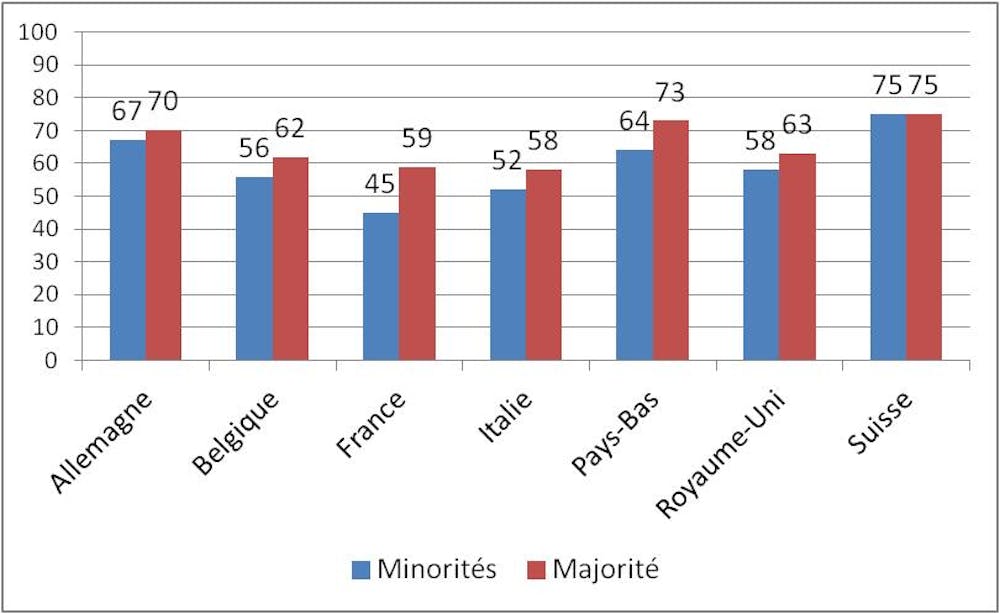
The survey shows that trust in the police (here defined as a high level of trust, indicated by scores between 7 and 10 on a scale from 0 to 10) is consistently lower among respondents who identify as belonging to an ethnic minority group.
Although the average level of trust in the police varies from country to country, the gap between the responses given by those who identify as belonging to ethnic minority groups and those given by respondents from the majority group is, once again, the widest in France.
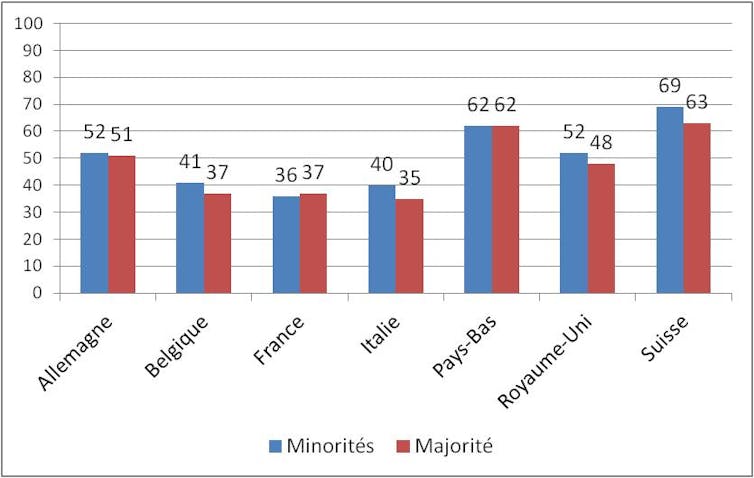
In contrast, the results regarding trust in the justice system (calculated in the same way) are quite different.
It is indeed among ethnic minority groups that this trust is strongest. In this regard, there is no difference in France between the responses given by members of minority groups and those of the majority group. The only observation is that the average level of trust in the justice system is the lowest among all the countries examined, which confirms the findings of other surveys, notably that of the Barometer of the Cevipof's Political Trust Index.
This relatively stronger trust in the justice system among ethnic minority groups could be explained by the fact that some of the respondents who are members of these groups come from countries where the justice system is particularly dysfunctional or corrupt. Moreover, 50 % of members of minority groups in France were not born there, as were 70 % of those in the United Kingdom and 80 % of those in Italy.
Ethnic minority groups with strong ties to their country of residence
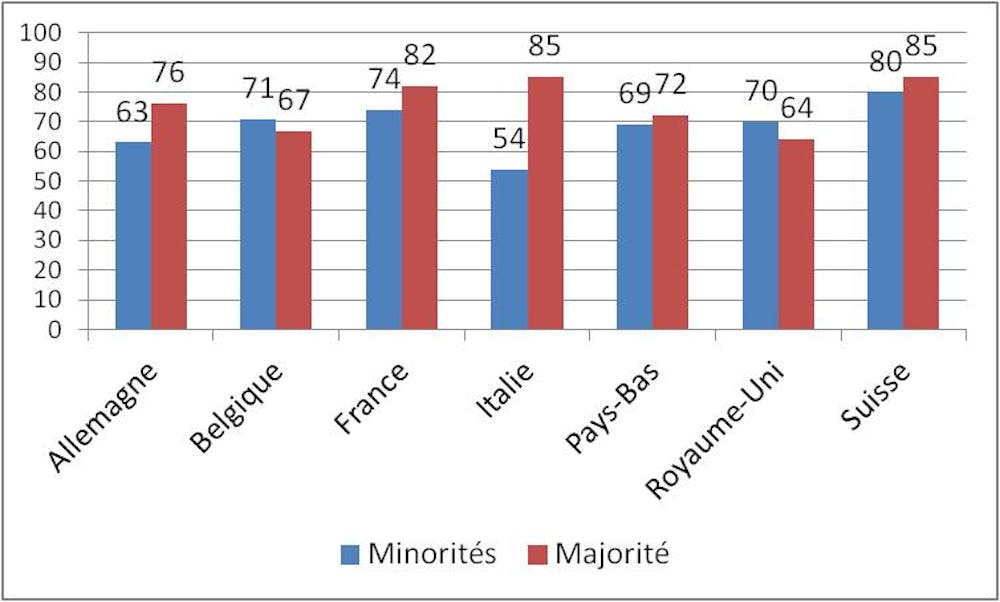
That said, the existence of actual or perceived discrimination does not prevent members of ethnic minority groups from feeling a strong emotional attachment to the country where they live.
This is particularly—and paradoxically—the case in France, where this proportion (calculated in the same way as before) is 74 %, the second-best result after Switzerland (80 %), whereas emotional attachment to the country of residence is only 54 % in Italy, where the contrast with the majority group in this regard is the strongest. In Belgium and the United Kingdom, members of ethnic minority groups even appear to be more attached to their adopted countries than members of the majority group.
The debate in France on ethnic discrimination must therefore take these various findings into account. The feeling of being discriminated against is stronger in France among those who identify as belonging to an ethnic minority, and it fuels greater distrust of the police but not of the justice system. Nevertheless, this does not mean a rejection of their adopted country.
One might hypothesize that the responses given by respondents in France may stem from disappointment with a country that strongly emphasizes its universalist mission—a country to which they feel a strong attachment.
This clearly touches on the issue that plagues French democracy: the disconnect between its ideals and the realities on the ground—or, at the very least, the feelings that these realities give rise to.