




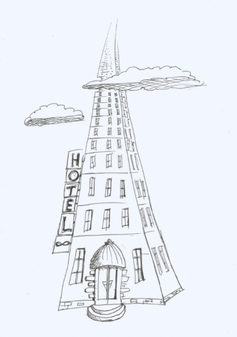
Let’s go crazy this year for vacation—let’s open an infinite hotel. Yes, you read that right: a hypothetical hotel with a countably infinite number of rooms. An infinite set is said to be countable when its elements can be listed without omission or repetition in a sequence indexed by the integers. So we can number the rooms: Room 1, Room 2, and so on to infinity. Each room accommodates a single guest.
What would be the advantage of this innovative hotel?
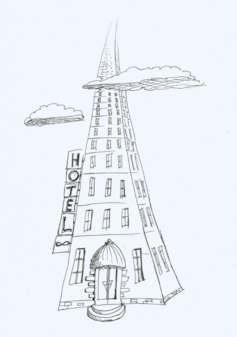
 Illustration of the Infinite Hotel by Julie De Saedeleer. Author provided
Let’s imagine that every room in our infinite hotel is already occupied—the hotel is fully booked! A new guest arrives at the front desk and wants a room. Bad news? No! The properties of infinity will allow us to find one for him. But how do we do that? The front desk clerk has an idea. He knocks on the door of Room 1 and asks the guest to move to Room 2; then he asks the guest in Room 2 to move to Room 3, and so on. Each guest moves from room N to room N+1, and since there are an infinite number of rooms, there’s a new room for every guest. After this lengthy process, the tireless receptionist informs the traveler that the first room is now available for the night; all that’s left is to put fresh sheets on the beds for everyone and say good night.
This remarkable hotel can also accommodate an entire busload of travelers even when the hotel is already fully booked. Let’s say a bus carrying 20 new guests arrives. The ingenious front desk clerk uses the same idea and this time asks the guest in Room 1 to move to Room 21, the guest in Room 2 to move to Room 22, and so on. Each guest moves from room N to room N+20, and the problem is solved: the 20 travelers from the bus each settle into one of the first 20 rooms, which are now empty. This process works regardless of the finite number of travelers who arrive. Fantastic, but it’s very likely that you’ll be asked to move several times during the night.
Now, let’s imagine that an infinite bus, filled with a countably infinite number of passengers (Passenger 1, Passenger 2…), arrives at our hotel, which is fully booked. Our trusty receptionist, initially perplexed, quickly figures out how to accommodate this infinite number of new passengers!
What about you?
To do this, an infinite number of rooms must be vacated—for example, all the odd-numbered rooms. So our receptionist asks the guest in Room 1 to move to Room 2, the guest in Room 2 to move to Room 4, the guest in Room 3 to move to Room 6, and so on. This time, the guest in Room N moves to Room 2N. The even-numbered rooms are now all occupied, leaving all the odd-numbered rooms free to accommodate the new guests. Everyone is happy—except perhaps the hotel staff, who definitely never stop changing the sheets.
Our infinite hotel is building quite a reputation, because there's always room, no matter how many people show up.
We can take this thought experiment even further by imagining that an infinite countable number of buses, each carrying an infinite countable number of passengers, arrive at our hotel, which is always full. The receptionist can once again rely on mathematics for help, drawing on the infinity of prime numbers. Prime numbers are natural numbers that have exactly two divisors: 1 and themselves. For example: 2, 3, 5… The countable infinity of prime numbers was proven by Euclid in the 4the century before Christ. He uses this result to create an infinite number of rooms capable of accommodating an infinite number of guests arriving on an infinite number of buses.
Hotel guests will move to rooms whose numbers are powers of 2 (the first prime number). For example, the guest in room 5 will move to room 2.5 (=32). The guest in Room N is therefore moving to Room 2N. Let's now move on to the first infinite bus, whose passengers will be sent to rooms numbered by the exponents of 3 (the second prime number). The passenger in seat 5 of the first bus will sleep in room 35 (=243). And so on for the infinite number of passengers on the infinite number of buses; passenger N on the 2e Bus will sleep in Room 5N, Customer N from 3e Bus will be staying in Room 7N. Since we use the exponents of prime numbers, there are no duplicate room numbers, and every guest can sleep soundly. Note that there are still an infinite number of empty rooms—those that are not exponents of prime numbers, such as room 6e bedroom.
Despite the colossal logistical effort required by this hotel, these experiences are only possible because we work with infinity—and in particular its smallest version, known as «countable infinity»—a concept we’ve used throughout when counting rooms, buses, guests… On the other hand, if a finite hotel—no matter how large it may be—is fully booked, it is impossible to accommodate even one more guest.
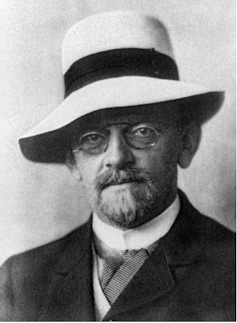
Our infinite hotel, often called Hilbert's Hotel, is a thought experiment devised by the mathematician David Hilbert (1862–1943) that illustrates the eponymous paradox describing the counterintuitive properties of infinite sets.
Above all, this thought experiment illustrates the difficulties we face in dealing with infinity, forcing us to abandon our habits of counting in finite sets.