



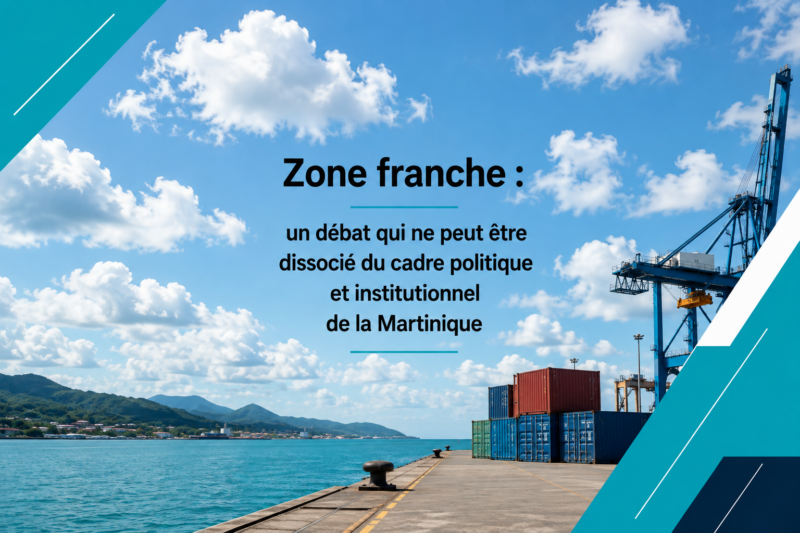
The debate over the creation of a free trade zone in Martinique regularly resurfaces in proposals for economic recovery. The idea is worth discussing, but it becomes largely a theoretical exercise when presented as a simple economic policy decision, without taking into account the institutional framework within which Martinique operates.
Martinique is neither the Cayman Islands, nor Bermuda, nor the British Virgin Islands.
It is a department and a region of the French Republic, an outermost region of the European Union. Its tax system, corporate law, customs policy, and a large part of its regulations are governed by the French government and European law. The Territorial Collectivity of Martinique does not have the fiscal sovereignty to create, on its own, a true free trade zone comparable to those that exist in certain Caribbean territories.
That is where the main limitation of the debate lies.
To discuss the advantages of a free trade zone without taking this institutional reality into account is tantamount to reasoning as if Martinique had the same powers as a state or a territory with broad fiscal autonomy. Yet this is not the case.
Even the powers provided for in Article 73 of the Constitution, however useful they may be, only allow for the adaptation of certain rules in limited areas. They do not grant the power to abolish the corporate income tax, to create an offshore tax regime, or to unilaterally alter the fundamental balance of French law.
History also explains this situation.
Since Martinique became a department in 1946, its economic development has been part of a process of integration into the French economy, based on government transfers, national solidarity, and the application of general law. This structure has led to undeniable social progress, but it also limits the scope for implementing an independent fiscal policy.
That doesn't mean change isn't possible.
Specific measures already exist in the overseas territories: exemptions from social security contributions, tax incentives for investment, the “octroi de mer” tax, free trade zones, and adjustments provided for under European law. However, each of these measures results from a decision by the French Parliament, the Government, or a European authorization. None of them can be implemented solely at the discretion of Martinique’s institutions.
The real question, then, is not whether a free trade zone would be desirable in theory.
The goal is to determine what capabilities would be needed to implement it, what negotiations would need to be undertaken with the government and the European Union, and what economic model it would follow.
Without this preliminary reflection, the debate risks remaining at the level of mere intentions. The comparison with Caribbean financial centers is intellectually stimulating, but it cannot ignore the fundamental differences in political status, fiscal sovereignty, and historical trajectory.
Ultimately, before discussing the expected effects of a free trade zone, we must first answer a more fundamental question: Does Martinique currently have the legal and political means to create such a system? Until this question is clearly addressed, the discussions remain more of a theoretical exercise than a genuine public policy initiative.
Gérard Dorwling-Carter