


Initially, the aid was primarily political in nature and consisted of 80% in grants, mainly intended for countries in the Soviet sphere of influence. In the 1990s, China’s transition to capitalism led to the creation of two state-owned banks whose assets are owned by the government: the’EximBank of China and the China Development Bank (CBD), both of which are destined to become the enforcement arm of the Middle Kingdom’s international policy.
In 2000, the first Forum on China-Africa Cooperation (FOCAC) was launched, intended to be held every three years, and was expanded in 2013 to include the well-known Belt and Road Initiative.
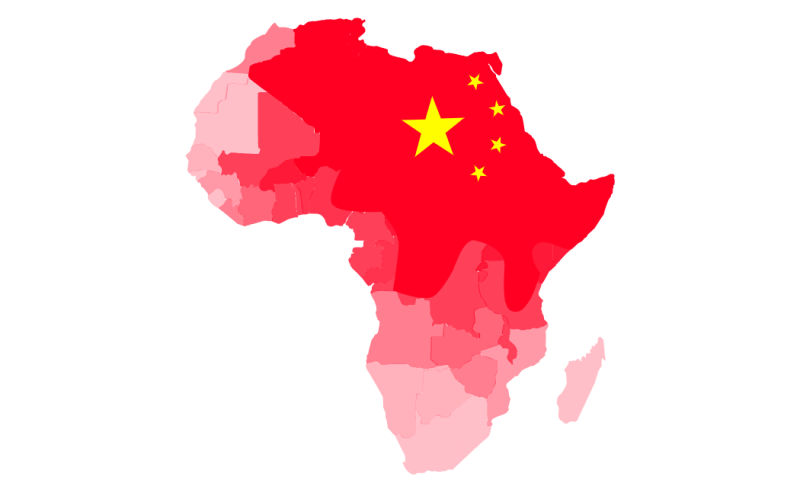
China, the leading donor to the African continent
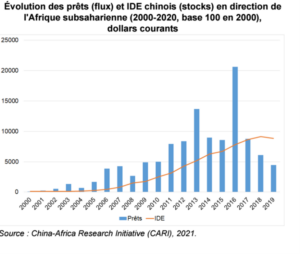
Since 2000, loans granted by Beijing have risen from 127 M$ annually to 5.8 Mds$ in 2019, peaking at 26.6 Mds$ in 2016, largely due to a 19 Mds$ loan to Angola. Over the course of a decade, China has become the leading bilateral lender to the African continent. Although Africa receives only 23% of China’s international loans—behind Asia (29%) and Latin America (24%)—these loans are steadily increasing, as shown in the following table:
Chinese FDI (foreign direct investment) flows to Africa have also seen a recent surge: during the 2018–2018 period, they accounted for 16% of the total, compared with 8% each for the United States and France, 6% for the United Arab Emirates, and 5% for the United Kingdom.
In 2009, China became Sub-Saharan Africa’s largest trading partner, accounting for 2.7% of its trade in 2019. African countries are also the top recipients of Chinese aid (42%), ahead of Asian countries (38%) and the Middle East (9%).
Between 2000 and 2019, the 140.9 Mds$ in Chinese loans should be compared with the 140.2 Mds$ in loans from multilateral and bilateral donors that are members of the DAC (Development Assistance Committee), which comprises OECD member countries. Six African countries account for 67.1% of China’s receivables: Angola, for which China accounts for 91% of bilateral external debt and 43% of total external debt; Ethiopia (77 and 24%), Zambia (83 and 27%), Nigeria (82 and 11%), Cameroon (66 and 34%), and finally Sudan (16 and 8%). The following table details the cumulative amount of loans by subregion of sub-Saharan Africa for the period 2000–2019:
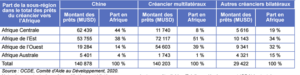
Did she, all by herself, Eximbank of China holds 57% in Chinese receivables in Africa, compared with 23% for the CDB. As part of the New Silk Roads initiative, China is demonstrating a strong need for infrastructure development. As a result, major projects are being financed, such as the expressway connecting the cities of Kampala and Entebbe in Uganda, the Standard Railroad Gauge in Kenya or the undersea fiber-optic cable connecting Asia to Europe via Djibouti. The main sectors benefiting from Chinese loans are transportation (31.2%), energy (25.5%), and mining (12.7%).
Chinese equity stakes in institutions with a long-standing presence on the African continent have also increased. China’s quota in the IMF rose from 6.4 billion SDRs (Special Drawing Rights) in 2001 to 30.5 billion SDRs in 2021, and it has risen to sixth place among contributors to the International Development Association with 1.2 billion$ in grants.
Advanced Predatory Strategies
The most notable characteristic of Chinese loans in Africa is undoubtedly their high level of opacity: it is estimated that 50% are not reported to the IMF and the World Bank. In practice, this hidden debt most often consists of circular loans—that is, loans paid directly into the account of the Chinese company in charge of the project, bypassing the borrowing government.
In addition, Chinese contracts frequently require the establishment of a specific bank account to serve as collateral for repayment, into which project revenues must be deposited—outside the borrowing country and under Chinese control. So-called clauses cross-default The following provisions are also included: specifically, China may suspend a loan and demand its immediate repayment if the country defaults on its obligations to other lenders; moreover, the resolution of disputes would take place under the jurisdiction of a Chinese court.
The CBD even includes policy provisions: half of its contracts contain a clause cross-default which can be triggered by the expropriation of Chinese companies or even simply by actions «contrary to the interests of China or Chinese entities.» In the event of default, China may sever diplomatic relations and require the borrowing country to make full and immediate repayment. The Chinese also routinely require borrowers to use the services of Chinese companies for their projects through an export credit system.
China uses its loans to control the countries it finances and, if necessary, to subjugate them—notably through the Silk Roads. The example of the port of Hambantota in Sri Lanka speaks volumes: after finding itself unable to repay its creditors, Sri Lanka was forced to cede the port to the Chinese for 99 years, with the Chinese paying only 1.12 billion$ for the acquisition. In practical terms, the Middle Kingdom is advancing its interests in Africa and scoring major successes at the expense of naive European countries—and first and foremost, our own. When will we stop letting ideology cloud our relations with Africa? When will we make the granting of our aid and loans contingent on the use of services provided by French companies? These are simple solutions, and no one seems surprised that they aren’t being implemented.