





Business bankruptcies are rising sharply in the overseas departments. In the second quarter of 2026, 709 insolvency proceedings were recorded in the overseas departments, representing a year-over-year increase of 30 %. Martinique is among the hardest-hit territories, with a 45 % increase, amid challenges facing the retail and service sectors.
The financial situation of overseas companies continues to deteriorate. According to the latest study published by Allianz Trade, the overseas departments recorded 709 business failures during the second quarter of 2026. This figure represents an increase of 30 % compared to the same period in 2025. For the first half of the year as a whole, the increase reached 23 %.
This trend represents the sharpest increase observed nationwide. It comes on the heels of an already difficult 2025, during which 2,321 overseas companies were subject to insolvency proceedings—a 16.% increase, compared with 4.% nationwide.
Martinique is particularly vulnerable
Martinique recorded a 45 % increase in business failures in the second quarter of 2026. This brings it to a level close to that of Guadeloupe, where the increase reached 46 %. Réunion, for its part, posted a 36 % increase.
These figures confirm a rapid deterioration of the economic fabric in island regions. For many businesses, the difficulties are no longer merely the result of a temporary slowdown in activity. Rather, they reflect a buildup of pressures related to operating costs, financing, weak consumer spending, and a succession of economic crises.
Réunion remains the territory with the highest number of proceedings, accounting for 48 % of the insolvencies recorded in the overseas territories. The trend continues to show a strong upward trajectory, despite a slight decline of 2 % observed in 2025.
French Guiana is the only overseas department to show an improvement in the second quarter of 2026, with a decline of 29 %. However, this decline should be interpreted with caution. It follows a surge of 194 % in 2025, which the study attributes in particular to a comparison effect linked to the post-COVID period.
Retail and Services on the Front Lines
The decline is not limited to a single sector. It affects a significant portion of the overseas economy, with a particularly sharp increase in retail and services.
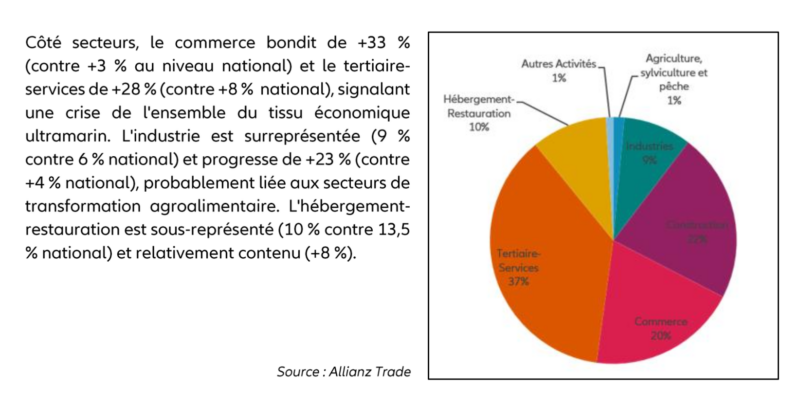
Business failures rose by 33 % in the retail sector, compared with just 3 % nationwide. In the tertiary and service sectors, the increase reached 28 %, compared with 8 % for France as a whole. According to Allianz Trade, these results signal a crisis that is spreading throughout the overseas economic fabric.
The industrial sector is also affected. It accounts for a larger share of business failures in the French overseas departments than at the national level and has seen an increase of 23 %, compared with 4 % in France. The study suggests, in particular, that difficulties are affecting the agri-food processing sector.
For the time being, the lodging and food service industry appears to be experiencing a less dramatic decline. Bankruptcies in this sector have risen by 8 %. The sector is also less heavily represented in insolvency proceedings in overseas territories than in national statistics.
This sector-wide trend is particularly concerning for overseas economies, where trade and services play a vital role. A rise in business failures in these sectors can have direct consequences for employment, suppliers, landlords, social service agencies, and the entire payment chain.
A significant deviation from the national trend
France as a whole continues to face a high rate of business failures, but the increase remains significantly lower than that observed in the overseas departments.
In the second quarter of 2026, 18,004 business failures were recorded nationwide. This represents an increase of 5.% compared to the second quarter of 2025, following a 6.% increase in the first quarter. The first half of the year saw a total of 37,298 insolvency proceedings.
The second quarter of 2026 thus marks a historic high for this time of year. The previous record, set in the second quarter of 2025, stood at 17,184 bankruptcies.
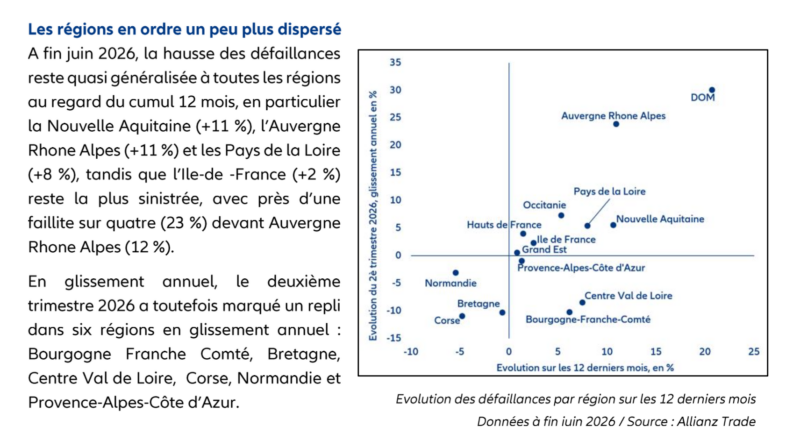
In the French overseas departments, the increase of 30 % is therefore six times greater than the national increase recorded over the same period. In the first half of the year, the overseas increase of 23 % also falls far short of the national increase, which was limited to 5 %.
Even large companies are no longer spared
The challenges are no longer limited to very small businesses. Since 2025, the rise in business failures has been concentrated among both the smallest businesses and those with the highest revenue.
At the end of June 2026, bankrupt companies for which financial data was available accounted for a combined revenue of 38.7 billion euros. This figure is up 17 % year-over-year and is 59 % above the average observed between 2006 and 2025.
Total accounts payable to suppliers, meanwhile, reached 8.6 billion euros, representing a 28 % increase over the past year and a level 70 % above the historical average.
These data show that the closure or restructuring of a company can now have significant repercussions on its subcontractors and partners. In overseas economies, where businesses are often highly interdependent, the failure of one company can quickly destabilize several others.
More than 70,000 bankruptcies are expected in 2026
Allianz Trade does not foresee any immediate relief. Weak growth, inflation, ongoing challenges in the construction sector, and persistently high interest rates continue to weigh on businesses. Geopolitical uncertainties, particularly in the Middle East, also pose an additional risk factor.
In this context, the number of business failures could exceed 70,000 in France in 2026. A decline would only be expected gradually in 2027, provided that economic conditions improve.
For businesses in Martinique and, more broadly, in the French overseas territories, these results serve as a warning sign. The 45 % increase recorded in Martinique indicates a level of vulnerability higher than the national average. It underscores the need for businesses to pay closer attention to their cash flow, payment terms, exposure to bad debt, and the financial stability of their customers.
It also calls on economic stakeholders and public authorities to analyze the local causes of this acceleration in greater detail. Beyond the number of bankruptcy proceedings, what is now at stake is the region’s ability to retain its businesses, its skilled workforce, and its jobs.
Download the report