



By entrusting Dominique Bussereau and Jean-François Debat with a task force on the institutional organization of the Marseille metropolitan area, the government acknowledges that a territorial structure can be reconsidered when its finances falter. This line of reasoning can be applied to other situations.
A Timeline of Restraints
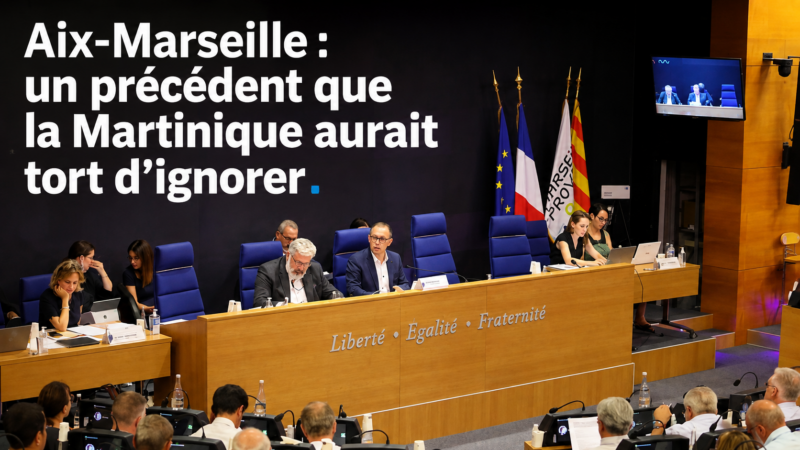
On April 28, 2026, elected officials of the Aix-Marseille-Provence metropolitan area refused to approve their budget, citing a deficit of 123 million euros. The move was as much political as it was financial: the presidency had just changed, with Nicolas Isnard succeeding Martine Vassal a few weeks earlier.
The prefect of Bouches-du-Rhône referred the matter to the regional audit office on May 11. Following the opinion issued on June 11, he personally approved the metropolitan area’s budget, confirming the 91 million euros in savings identified by the chamber and refusing to increase the tax burden on households and businesses.
On June 24, elected officials postponed their own vote until the fall, using an emergency procedure, in order to secure the 144 million euros in savings now required. It is this postponed vote that the task force announced on July 30 is awaiting before it can begin its work.
Composition is a message
The government has not authorized either the General Inspectorate of Finance or any other oversight body. Instead, it appointed a duo drawn entirely from the world of elected officials’ associations: on one hand, the former minister and former president of the Assembly of French Departments; on the other, the president of the Local Finance Committee, elected on June 9 to replace André Laignel.
The political balance is clear: a former right-wing lawmaker and a Socialist mayor. The choice based on legitimacy is just as clear: the state is seeking an institutional agreement negotiated among elected officials, not an audit report—the Regional Audit Office has already provided that.
A timeline that contradicts the stated ambition
Work begins in late September, and proposals are expected by the end of the year. A report submitted by that date will reach the government after the 2027 budget bill has been introduced and on the eve of the presidential campaign: no credible legislative vehicle will be available before the summer of 2027 at the earliest. The task force will therefore produce a reference document for the next five-year term, which is no small feat, but does not constitute a solution to the crisis.
Financial distress is becoming a valid grounds for revising the territorial structure.
The precedent
The scope of the project is the key factor. The mission will focus on the metropolitan area’s institutional organization, its governance, the allocation of responsibilities, the relationships between the intermunicipal body and its member municipalities, and the financial mechanisms.
However, this structure has already been revised once. Created on January 1, 2016, through the merger of six public intermunicipal cooperation agencies, the metropolitan area saw its governance simplified and certain local authorities returned to the municipalities under the law of February 21, 2022. The government has therefore agreed to revise it a second time, ten years after its creation, on the grounds that its finances have collapsed.
That’s where this precedent becomes interesting for Martinique.
The Territorial Collectivity of Martinique was also formed through a merger that took effect in late 2015. It is carrying a legacy deficit of 213.7 million euros and is implementing a cost-optimization plan under sustained financial constraints.
However, the government has not launched any independent assessment mission there regarding governance and the distribution of powers. On July 1, 2026, it signed a bilateral framework agreement with the current executive branch, focusing on the regulatory powers and authorizations set forth in Article 73.
Two crises, two approaches
In Aix-Marseille, The government refers the matter to the regional audit office, sets the budget itself, and then commissions a counter-assessment to be conducted by two elected officials with opposing political views, with an explicit mandate regarding the institutional framework.
In Martinique, he negotiates directly with the local government’s executive branch a framework agreement covering regulatory authority, without any external oversight of governance or the sustainability of the financial model.
The two situations are not identical: the Marseille metropolitan authority rejected its budget, while the CTM approved its own. Nevertheless, they share a common set of challenges—a recently established organizational structure, a constrained financial trajectory, and an unstable relationship with the municipalities.
The Question to Ask
There is no obvious answer to that question. An independent assessment of the CTM’s governance would provide an outside perspective that the local authority could use as leverage in its dealings with the government—or it could be an initiative over which it would have no control, neither in terms of its scope nor its conclusions.
The precedent set in Marseille makes one thing clear, at least: When the government wants to address a regional financial crisis, it knows how to raise the institutional issue and allocate resources to it. The fact that it did not do so in the case of Martinique was a choice, not an impossibility. The question remains: which of the two parties had an interest in ensuring that the issue was not raised?.
Gérard Dorwling-Carter