


The End of a Model
Martinique has reached the end of an economic cycle. For several decades, its development was based on a balance between national solidarity, domestic consumption, public investment, tax breaks, and private initiative. This model has led to considerable progress, but it is now showing its limitations.
The government no longer has the budgetary leeway that once allowed it to sustain this trajectory over the long term. At the same time, international competition is intensifying, markets are undergoing restructuring, and island economies have no choice but to strengthen their competitiveness and capacity for innovation.
The question, then, is no longer whether we should change our model, but how we should organize ourselves to make this transition a success.
Regaining Financial Sovereignty
Entrepreneurs in Martinique have been left without support since the closure of Crédit Martiniquais. This closure has deprived the territory of a financial decision-making tool rooted in local realities.
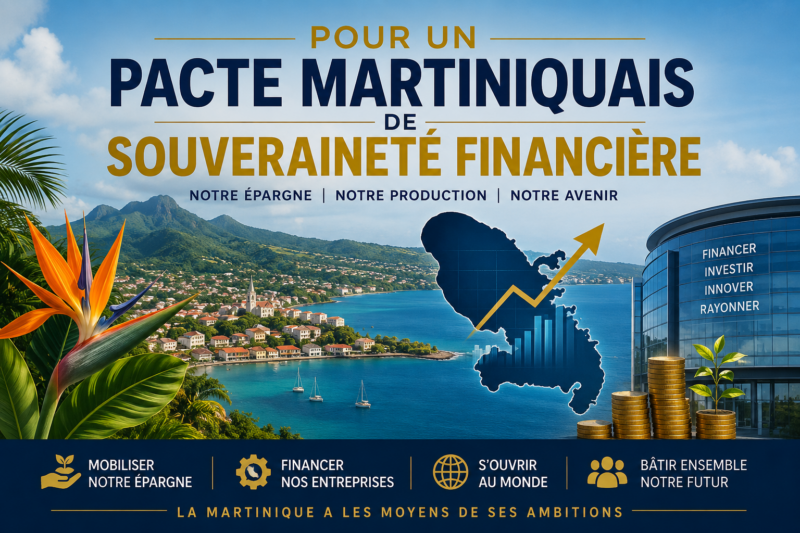
Obviously, this is not about recreating an institution from the past exactly as it was. The goal is much more ambitious: to create a new financial instrument for Martinique—one that is modern, effective, and open to the world—capable of supporting businesses, innovation, energy transitions, the digital sector, industry, agriculture, and the blue economy.
Successful island economies are those that have the financial tools to invest in their own future.
Learning from Our History
Crédit Martiniquais, combined with the tax exemption mechanisms established by the Pons Act, contributed significantly to the region’s development in the 1980s, 1990s, and 2000s. This period saw the emergence of tourism, commercial, and industrial infrastructure that still constitutes an essential part of our economic heritage today.
This experience demonstrates that effective financial engineering can accelerate transformation when it is part of a long-term vision.
Putting Martinique’s savings to work for Martinique
Every year, households in Martinique accumulate significant savings. However, a large portion of these funds is used to finance investments made outside the territory.
It is time to consider a strategy that will allow us to channel more of these savings toward our own development.
This would involve the creation of regional investment funds, vehicles specializing in financing innovative SMEs, export-oriented companies, and infrastructure projects, as well as a review of the complementarity between pay-as-you-go pension systems and funded pension plans that invest effectively in the Martinican economy, within a secure and strictly regulated framework.
Building an Open Economy
Martinique must look to the Caribbean, the Americas, Europe, and Africa. It must support the export of its expertise, foster the emergence of regional leaders, assist its companies in expanding internationally, and attract capital to fuel its development.
Openness is not a threat; it is essential for the growth of an island economy.
Making Excellence Part of Our Culture
All public policies, financial tools, and economic strategies will remain inadequate without a genuine culture of excellence.
Our greatest asset lies in the women and men of Martinique—in their level of education, their creativity, their entrepreneurial spirit, and their drive to innovate.
Excellence is not just a slogan. It must become a method, a standard, and a shared goal.
A Pact for the Next Generation
Martinique has the expertise, entrepreneurs, talent, and savings needed to successfully embark on a new cycle of development.
What it still lacks is a shared vision, underpinned by a genuine pact for financial sovereignty that brings together businesses, banks, investors, local governments, universities, diaspora communities, and all the driving forces of the region.
The future will not be built by repeating the formulas of the past, but by inventing the tools of tomorrow. If we can harness our collective intelligence, our savings, and our entrepreneurial spirit, Martinique can become a model among the most innovative and successful island economies.
Mikaël Glondu-Monnerville