




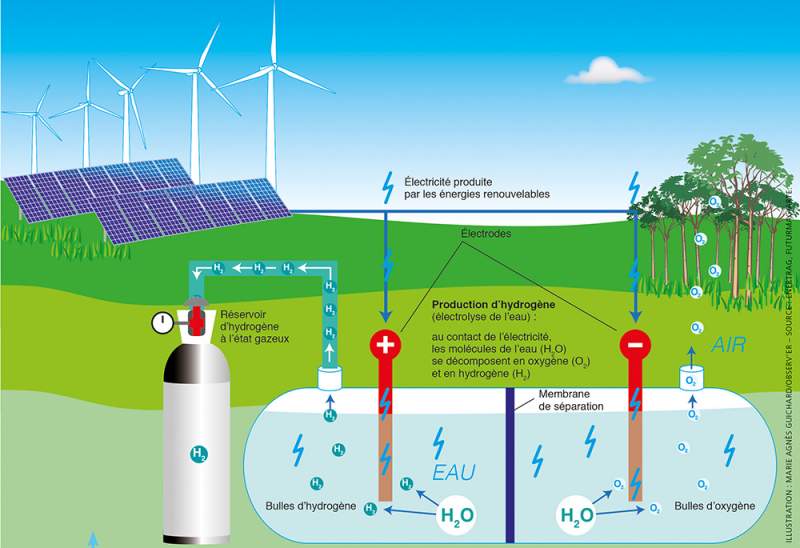
The solution to the problem of electricity storage and intermittent energy?
On January 13, Siemens Gamesa and Siemens Energy announced a partnership to build a «.” The idea is to integrate an electrolyzer directly into the turbine to convert wind energy into hydrogen. The electrolyzer will be placed at the base of the mast and synchronized with the turbine’s operation.
Renewable energy sources have a major advantage: although their production and recycling are not environmentally neutral, they emit little CO₂ when used.2 or pollutants. But they also have a major drawback: they are intermittent and cannot be stored.
To resolve this dilemma, hydrogen can be used to temporarily store the electricity generated. One of the simplest ways to do this is to electrolyze water, separating the hydrogen and oxygen molecules.
The problem is that this process consumes a great deal of energy, which is why it must be powered by so-called green energy; otherwise, it will cause even more pollution. Today, more than 95% Hydrogen The energy consumed worldwide is derived from fossil fuels, primarily natural gas, through vapor reforming.
And that works out well, because there’s actually an abundance of water right at the base of the offshore wind turbines. «[Thanks to this integrated system], electrical losses are minimized, while a modular approach ensures reliable and efficient operational deployment for a scalable offshore wind-to-hydrogen solution.», ", writes the manufacturer.
Promises and Limitations
This wind turbine will thus meet two objectives: adding value to offshore wind turbines and providing a competitive green hydrogen solution for industry.
It will also allow wind turbines to operate off-grid by providing a certain degree of autonomy—one of the major problems with wind power today is that it destabilizes the grid, causing significant spikes and dips. «This will allow us to develop more and higher-quality wind farms.», ", says Christian Bruch, CEO of Siemens Energy.
A prototype will initially be integrated into «the world's most powerful turbine», the SG 14-222 DD, manufactured by Siemens Gamesa, with a capacity of 14 MW.
This giant wind turbine, capable of circulating 39,000 cubic meters of air and measuring 222 meters in diameter, is the ideal housing for relatively large electrolysers. Siemens Gamesa and Siemens Energy will invest 120 million euros in this project, with the goal of bringing such a wind turbine online in 2025.
Despite the obvious advantages of this technology, storing wind energy is far less cost-effective than using it directly. First, water electrolysis is four times more expensive than steam reforming (around 6 euros/kg).
The efficiency of the electrolysers is at best 75%, which means that a quarter of the electricity generated is lost in the process. It is also unclear where and how the hydrogen will be stored.
Nevertheless, this system appears promising, in that it addresses one of wind power’s major shortcomings (its intermittency). In most cases, a wind turbine’s load factor does not exceed 25%.