




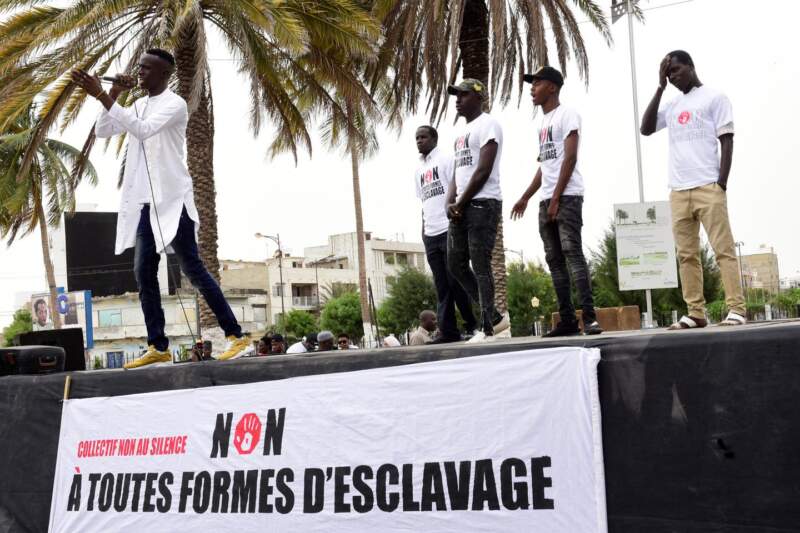
In November 2017, images of Black men being auctioned off near Tripoli shocked the world. Nearly nine years later, these images have taken on a terrible new relevance: a United Nations report published in February 2026 still describes a system of human trafficking, forced labor, violence, and exploitation of migrants in Libya. The scandal of 2017 is therefore not merely a thing of the past.
On November 14, 2017, CNN aired the investigative report by journalist Nima Elbagir.
A few weeks earlier, his team had traveled covertly to the outskirts of Tripoli after receiving a video showing a human trafficking operation.
A dozen African migrants are presented to buyers. Their physical strength is touted as if they were merchandise. The bidding escalates, and within minutes, the men are sold for a few hundred dollars. The scene seems to come straight out of another century.
Yet she wasn't a stranger.
As early as April 2017, the International Organization for Migration had warned of the existence of «slave markets.» Migrants reported being bought, resold, forced to work, and held captive until a ransom was paid. Other accounts described torture and sexual violence.
So CNN hadn't really exposed the phenomenon: the network had given it a face. And that face had made it much harder to remain indifferent.
From Libya’s Collapse to a Predatory Economy
Following the fall of Muammar Gaddafi in 2011, the fragmentation of the Libyan state has created fertile ground for militias, human smugglers, and criminal networks. At the same time, the country remains one of the main routes used by migrants from sub-Saharan Africa attempting to reach Europe.
When a migrant can no longer pay for their passage, they themselves can become a source of income: forced labor, ransom, sexual exploitation, or resale. Human beings become commodities that can be monetized multiple times.
The international outcry in 2017 was considerable.
Emmanuel Macron calls it a crime against humanity. The UN Security Council takes up the issue. The African Union demands that those responsible be prosecuted, and at the Africa-Europe Summit in Abidjan, cooperation is organized to evacuate migrants stranded in Libya.
Then the excitement subsides.
2026: «Business as usual»
That is what makes this case so strikingly relevant today. In February 2026, the Office of the United Nations High Commissioner for Human Rights and the United Nations Support Mission in Libya published a report with the damning title: *Business as Usual*.
For the 2024–2025 period, investigators continue to document murders, torture, sexual violence, human trafficking, extortion, forced labor, forced prostitution, and domestic servitude. Even more disturbing: they report information regarding the sale of human beings that may constitute slavery, particularly around Sabha and Al-Zawiya.
In other words, the auctions filmed in 2017 cannot be viewed as a snapshot of a phenomenon that has disappeared. Nearly nine years after the global outcry, these predatory practices persist.
International justice is certainly beginning to make progress. The case against Khaled Mohamed Ali El Hishri, the former head of Mitiga Prison, marks a significant step forward in the fight against impunity in 2026. But it does not represent the trial of the sales filmed by CNN.
Europe also continues to face a major contradiction.
Since 2017, it has supported the monitoring of departures from the Libyan coast, even though intercepted migrants may be returned to a territory where arbitrary detention, torture, and exploitation have been documented. It would be wrong to hold the European Union responsible for the slave trade. But the question remains: can we outsource the control of our borders without taking responsibility for the fate of those we help send back? ?
A question for Martinique as well
In the Caribbean, these images inevitably have a special resonance, though we must not confuse the transatlantic slave trade and colonial slavery—an economic, legal, and political system that existed for several centuries—with the criminal networks of contemporary Libya.
But a certain moral line has been crossed: the one that turns a human being into a commodity and sets their price based on their capacity for work.
This may be where current events in Libya directly resonate with Martinique. A memory of slavery focused exclusively on the past risks losing some of its universal significance. Remembering must also enable us to recognize contemporary forms of servitude when they arise elsewhere, even far from us.
In 2017, the images from Tripoli shocked the world because they seemed to come from another era. The 2026 United Nations report forces us to admit that they also spoke to our own time. Gdc