


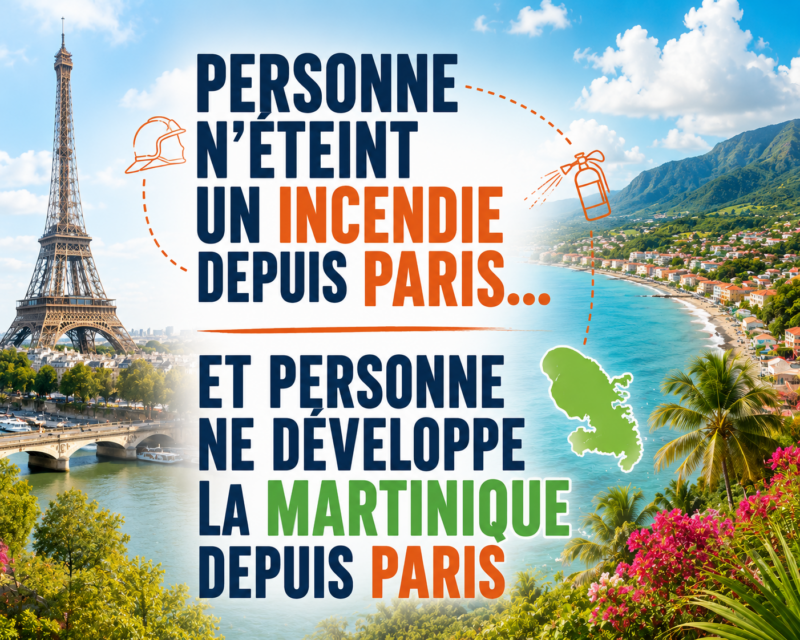
The major wildfires this summer have sparked a great deal of commentary. One of the most thought-provoking pieces was published in the editorial section of *Le Figaro*. Looking beyond the flames, the author points out the obvious: «No one puts out a fire from the capital. » A simple sentence, but one that says a great deal about the way we organize public action.
When a disaster strikes, the government is indispensable.
It coordinates efforts, mobilizes national resources, and ensures solidarity. But it is the men and women on the ground who make the critical decisions: firefighters, mayors, farmers, and volunteers. Their effectiveness stems from one thing: they know their local area.
Why should this obvious fact suddenly disappear when the topic turns to the development of overseas territories?
Located nearly 8,000 kilometers from Paris, Martinique faces the daily consequences of a system in which responsibility lies at the local level but standards remain largely centralized. Elected officials are judged on water quality, transportation, urban planning, housing, economic development, and the energy transition. Yet they often find themselves bogged down by lengthy procedures, multiple permits, and regulations designed for circumstances that do not apply to them.
We all know the result: a delayed decision sometimes becomes a pointless one.
A uniform standard ultimately leads to uneven results. And then local governments are criticized for their lack of responsiveness, even though they do not always have the necessary tools to take action.
This is not about pitting Paris against Martinique.
Nor is it a matter of calling for the elimination of the state. The state remains the guarantor of national unity, equality before the law, and solidarity. But a modern state is also one that knows how to distinguish between what must be decided at the national level and what can be better decided locally.
Article 73 of the Constitution has already recognized this, providing the authority to adapt certain standards. The framework agreement concluded between the State and the Territorial Collectivity of Martinique on July 1, 2026, follows this same logic: recognizing that an island territory is not governed in exactly the same way as a mainland department.
Ultimately, the issue is less legal than political.
To govern is to be willing to trust. If we trust local stakeholders to save a forest, why hesitate to trust elected officials to adapt the rules that will enable them to develop their region?
The real purpose of local legislative authority is not to create a different Republic. It is to make the Republic more effective. Trust does not mean giving up control; it is the natural complement to accountability.
The fires may have taught us a lasting lesson. You can’t protect a forest from an office in Paris. Similarly, you can’t build Martinique’s future solely from within government ministries.
Principles may be national; solutions, however, must often be regional. Perhaps that is what truly defines the Republic’s modernity today.Gdc