


Five Op-Eds on a New Development Model
Martinique has reached a critical juncture. An aging population, sluggish wealth creation, the ecological and digital transitions, budgetary pressures, and institutional challenges all require us to rethink our development model.
We are offering our readers a series of articles that presents neither a political platform nor a list of measures. It puts forward a simple idea: Martinique already has the human, cultural, economic, and institutional resources to embark on a new chapter in its history, provided that excellence becomes a guiding principle and the creation of value a shared goal.
Through five opinion pieces—written by Mikaël Glondu-Monnerville—the aim is to show how a region can make better use of its current capabilities, prepare for the future, strengthen its governance, and build an economy based more on responsibility, innovation, and control over its own development. Gdc
THE MARTINIQUE OF TOMORROW
«The best experts on Martinique are the people of Martinique.» — Pierre Aliker
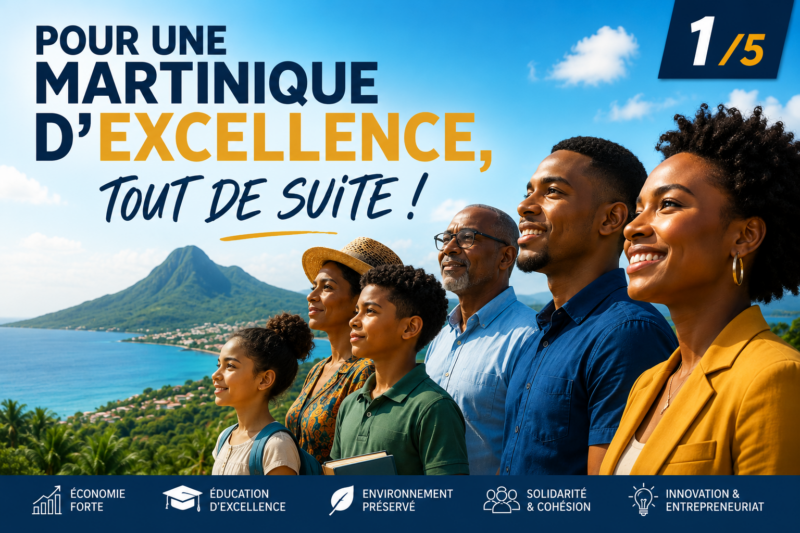
Martinique is going through a critical period. Population decline, economic slowdown, technological changes, ecological transition, and institutional debates call for a fundamental rethinking of its development model. This first op-ed puts forward a simple idea:
True change begins with a culture of excellence—not as a slogan, but as a method of governance, production, and collective action..
Before discussing the skills of tomorrow, let’s make the most of the ones we already have. Only then will Martinique be able to turn its strengths into lasting prosperity.
Making Excellence a Collective Effort
Martinique can no longer be viewed as a peripheral territory doomed to manage its vulnerabilities. It must see itself as a territory capable of generating value, innovation, and influence. Its future lies not solely in preserving its heritage, but in its ability to transform that heritage into a competitive advantage.
At a time when competition among regions is intensifying, the ones that succeed are those that know how to highlight their uniqueness, raise their standards, and develop a coherent development strategy.
Martinique has considerable assets: a strong identity, an exceptional natural and cultural heritage, recognized expertise, and a prime location in the heart of the Caribbean. Yet these assets have not yet been sufficiently harnessed to generate sustainable prosperity.
The challenge, therefore, is not to seek a model from elsewhere, but to build a Martinican model based on a simple goal: to make excellence a collective standard.
This ambition goes far beyond economic performance alone. It encompasses education, training, research, agriculture, tourism, culture, infrastructure, public services, and governance. It requires moving away from a mindset focused on catching up and toward one focused on creating value. It is no longer just a matter of managing the challenges of the present, but of laying the groundwork for sustainable prosperity.
Legacy as Strategic Capital
The generations that came before us have not only passed down a heritage to us; they have bequeathed to us skills, landscapes, institutions, products, and an identity that today constitute a true strategic asset.
This heritage should not be viewed merely as a memento. It must become an economic, cultural, and social resource that contributes to development.
Excellence rarely happens by chance.
It is based on the quality of training, rigorous methods, attention to detail, the transfer of skills, and sustained collective effort. «Beauty» is never merely aesthetic: it reflects a commitment to quality that inspires confidence and creates value.
AOC Martinique rum is a striking example of this. Its international reputation is based not on the volume produced, but on the consistency of its standards. This same approach can inspire agriculture, food processing, crafts, gastronomy, lodging, the cultural industries, and the service sector as a whole.
A region that sustainably raises its standards improves its reputation. A better reputation attracts visitors, reassures investors, builds customer loyalty, and helps promote local products more effectively. Excellence, therefore, is not a cost—it is an investment that yields both economic and social benefits.
Making Martinique a land of excellence requires the involvement of all stakeholders—the French government, the Territorial Collectivity of Martinique, municipalities, businesses, educational institutions, organizations, and citizens. Everyone has a share of the responsibility. Because excellence is never simply decreed: it is built, organized, evaluated, and passed on.
An ambition that affects all sectors
Excellence cannot be reserved for just a few flagship sectors. It must permeate all of Martinican society. In education, it means training young people to succeed both here and elsewhere. In public services, it implies a more efficient, responsive, and results-oriented administration. In business, it requires a constant pursuit of quality, innovation, and competitiveness. In culture, it means making our identity a source of international influence. In tourism, it calls for prioritizing the quality of the experience as much as the number of visitors.
This collective need also calls for a change in behavior.
A society of excellence is built on trust, a sense of responsibility, punctuality, high-quality work, keeping one’s commitments, and a constant drive to improve. It does not depend solely on public policies; it also stems from the daily choices made by citizens, businesses, and institutions.
Shifting from a culture of catching up to a culture of creating value
For several decades, Martinique’s development has been largely driven by catch-up policies. These policies have led to considerable progress in terms of infrastructure, social protection, and standard of living. But today’s challenges call for a new phase.
The region must now generate more wealth, strengthen its capacity for innovation, improve its productivity, and develop new job-creating activities.
The goal is no longer simply to offset the disadvantages of being an island; it is to transform Martinique’s strengths into sustainable competitive advantages.
This development requires a long-term vision. Investments in education, research, innovation, infrastructure, and skills do not yield immediate results, but they are essential to prosperity in the decades to come.
Successful regions are those that know how to prepare for the future before they are forced to do so.
Excellence as a Method of Development
Ultimately, excellence is neither a luxury nor a slogan. It is a method of development. It involves striving for quality in every decision, performance in every public policy, value in every investment, and innovation in every project.
It is this culture that will enable Martinique to better cope with the economic, environmental, and technological changes currently underway. It is also this culture that will give full meaning to the debates on institutional reform.
For new skills will only have a lasting impact if they are grounded in a society that has embraced high standards, responsibility, and the constant pursuit of excellence.
Coming up: Generating More Wealth: Mastering Value Chains. This second opinion piece will explain why Martinique’s development also depends on better management of strategic sectors—from tourism to air travel—so that more of the wealth created in the territory remains there and provides lasting benefits to the people of Martinique.
Mikaël Glondu-Monnerville