




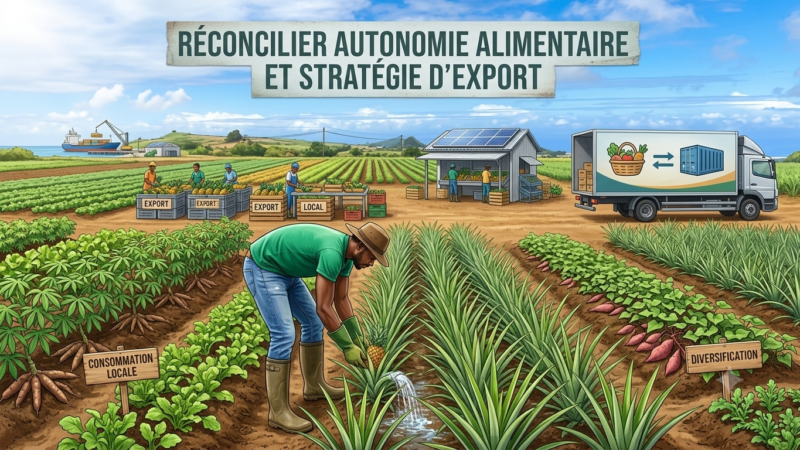
Shaped by a colonial history focused on exports, agriculture in the Caribbean today struggles to balance food sovereignty with competitiveness in foreign markets. At a time when the health crisis has exposed the vulnerability of global supply chains, the issue of food self-sufficiency has emerged as a strategic priority for overseas territories.
Colonial Legacy and Food Dependency
Long centered on sugarcane, rum, and bananas, agriculture in the French West Indies was designed to meet the needs of foreign markets, at the expense of meeting local needs. While local populations have maintained subsistence farming—often confined to the Creole garden—the export-oriented approach has persisted, spanning eras and withstanding economic and social changes.
The COVID-19 pandemic has served as a stark reminder of the fragility of this system. Supply disruptions and tensions in global markets have made food self-sufficiency a major issue once again, calling for a refocusing of agricultural policies on meeting local needs.
A Need to Reevaluate the Balance Between Local Production and Exports
The challenge now is to move beyond the dichotomy between food sovereignty and export strategy. The goal is to reorient agricultural production toward meeting the needs of overseas populations, while developing an export sector for surplus produce—particularly fruits and vegetables, whether fresh or processed. This dual objective requires adapting logistics infrastructure and support mechanisms, as well as a strong political commitment to providing agricultural businesses with the resources they need to grow in both domestic and European markets.
The Contrasting Realities of Guadeloupe and Martinique
In Guadeloupe, the usable agricultural area (UAA) dedicated to crop diversification is estimated to generate an annual surplus of more than 25,000 metric tons of fruits and vegetables, after local needs have been met. In contrast, Martinique, where the UAA is largely dominated by banana cultivation, barely manages to cover its own consumption, yielding only a meager structural surplus.
This observation highlights the inequality among agricultural models and the need for Martinique to begin a partial conversion of its banana-growing lands to food crops and market gardening. The goal is not to pit banana production against diversification, but to organize a gradual transition, guided and supported by existing programs such as POSEI.
Diversify to Weather the Storm: A Resilience Strategy
The move to export tropical fruits and vegetables, supported by a planned conversion of banana-growing land, addresses a twofold need: to capture new markets while safeguarding the local economy in the face of the vulnerability of monoculture. Recent events—whether health-related or climate-related—have demonstrated the fragility of a sector dependent on a single product. Diversification therefore emerges as a driver of resilience, provided it is accompanied by a structured export strategy capable of absorbing surpluses and stabilizing farm incomes.
The Logistical Challenge of Air Transport
The competitiveness of the Caribbean’s export sectors, however, faces a major obstacle: transportation costs, particularly air freight. While government subsidies cover a large portion of ocean freight, air freight—which is essential for the most fragile products—remains largely the responsibility of producers. For example, the cost of air freight for a Caribbean melon reaches 3.20 euros per kilo, well above the prices charged by international competitors.
To address this distortion, the creation of a logistics vulnerability index is proposed. This index would make it possible to target public aid based on the fragility of products, covering up to 90 % of the actual cost of air freight for the most sensitive goods. Such a measure would promote the diversification of export sectors, the promotion of local products, and job creation in the logistics sector.
Toward a Marketing Subsidy for Tropical Products
Beyond transportation, access to national and European markets requires increased government support. A specific subsidy for the marketing of tropical fruits and vegetables—whether raw or processed—is therefore being considered. Calculated at 10 % of the value of exported products, with an increase in the event of local processing, this subsidy would complement existing measures and address the structural disadvantages associated with geographic remoteness.
A Political and Legislative Opportunity
All of these measures are expected to be part of the bill to combat the high cost of living, which is currently being championed by the government. This represents a unique opportunity to overhaul the overseas agricultural model, strengthen territorial equity, and give Caribbean producers the means to expand into national and European markets. Ultimately, this strategy could pave the way for an ambitious reform of the POSEI program, which France would be in a position to advocate for before the European Commission.
Reconciling food sovereignty with export competitiveness is not a contradiction, but a necessity for the French West Indies. By enshrining these guidelines in law, France would affirm its commitment to supporting an innovative, sustainable, and integrated overseas agricultural sector capable of meeting consumer expectations and ensuring the economic resilience of its overseas territories.
Gérard Dorwling-Carter
P.S.: The technical data in this article was provided by an expert in agriculture in the French West Indies.