




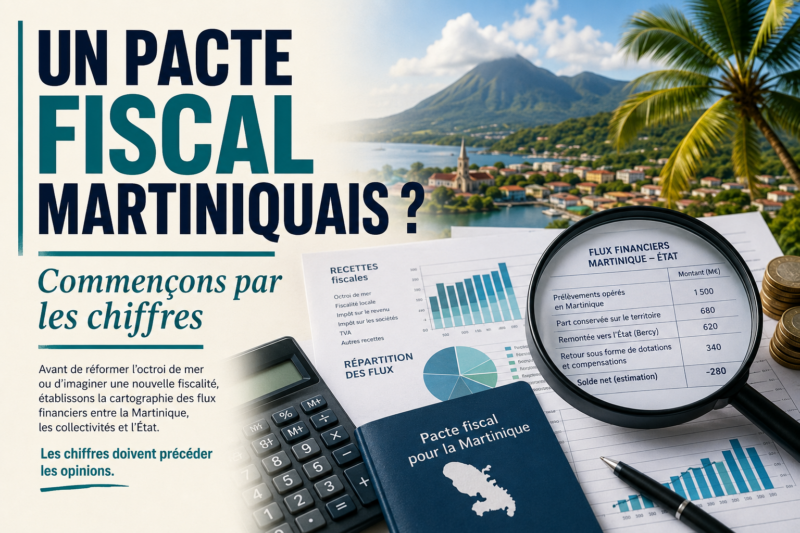
A Tax Pact for Martinique? Let's Start with the Numbers
Before discussing taxes, let’s finally map out the financial flows between Martinique and the French government.
The port tax has once again become one of the most sensitive topics in Martinique’s public debate. For some, it is one of the main causes of the high cost of living; for others, it remains the cornerstone of local government funding and an indispensable tool for supporting local production. Caught between these two positions, the debate often devolves into an ideological clash.
However, it is possible to approach this issue differently. Before deciding whether to retain, reform, or replace the dock dues, one thing is essential: knowing the facts. In other words, start with the numbers.
The real issue is not just the level of taxation.
This is a more fundamental question: How much revenue does Martinique actually collect? What portion of this revenue remains in the territory? What portion is centralized by the central government? What amounts are subsequently returned in the form of grants, compensation, or tax expenditures?
The key question: Where does the money actually go?
This financial snapshot should serve as the starting point for any reform.
– How much is actually collected in Martinique; ;
– how much remains for local governments; ;
– how much is transferred to the general state budget; ;
– how much of that then goes back to the region in the form of grants or compensation.
Toward a Martinican Tax Pact
The real issue is probably not whether to eliminate a tax or create a new one. It is about establishing a fiscal pact based on three principles.
– transparency in financial flows; ;
– clarification of the division of responsibilities between the federal government and local governments; ;
– the transparent allocation of revenue to the region’s public policies.
Because a fiscal pact isn't something you simply decree. It's something you build. And it always starts with the numbers.
Mikaël Glondu-Monnerville