




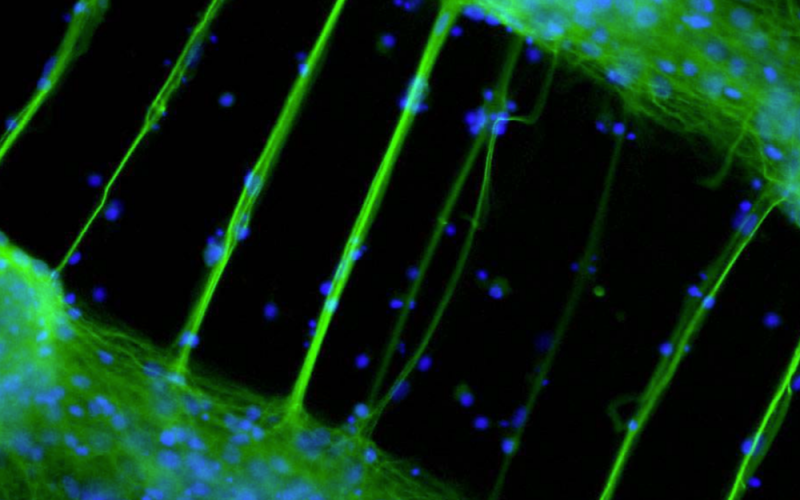
Fluorescence image of a cortical neuron culture. The cell membrane and axon are shown in green. The neuron's nucleus is shown in blue. Daisuke Ito, Author provided
Toward Brain Implants: When Artificial and Natural Neurons Communicate
July 23, 2020, 9:51 p.m. CEST
Authors
- Timothée Levi Associate Professor of Bioelectronics at LIMMS/CNRS-IIS, The University of Tokyo, and at the IMS, University of Bordeaux
- Paolo Bonifazi Ikerbasque Research Associate, Biocruces Health Research Institute, Ikerbasque Foundation
University of Bordeaux provides funding as a supporting member of The Conversation FR.
View Partners from The Conversation
We believe in the free flow of information
Reproduce our articles for free, in print or online, using our Creative Commons license
A prosthesis is an artificial device used to replace an injured or missing body part. Many examples come to mind: some athletes use them in para sports. In science fiction, they are central to certain characters, such as Darth Vader. Now try to imagine a prosthesis that replaces part of a damaged brain.
One of the challenges is getting the prosthesis to communicate with the biological body. For neuroprostheses designed to repair brain injuries, the goal is to get artificial neurons to «communicate» with real biological neurons. To this end, we have developed A new prototype in which artificial neurons transmit information to biological neurons and enable them to synchronize, all in real time. The stimuli from the artificial system are thus converted into neural activity in the biological system.
A New Generation of Neuroprosthetics
A neuroprosthesis is a device connected to the nervous system that can replace a defective organ. In recent years, there has been an emergence of’cochlear implant(a miniaturized implant to restore hearing), from artificial retina and brain-machine interfaces.
These types of neuroprostheses are «simpler» than brain prostheses would be, because they operate in only one direction: from the sensor to the stimulator—like the retina or a cochlear implant—or from the brain to the actuator—like arm prostheses or the Controlling a robotic arm with the brain.
One of the major challenges is designing a closed-loop system—from biology to artificial systems and vice versa—in which the system receives feedback based on the action taken, thereby enabling learning and resulting in a more reliable and accurate system. The second challenge lies in the complexity of the biological system, particularly the staggering number of neurons that need to be replaced: a few thousand in the retina, and several billion in the brain.
What is an artificial neuron?
There are actually two types of artificial neurons. In artificial intelligence, we often use formal neurons which can be modeled quickly and easily on a computer. This is a very different approach from «biomimetic neurons», which reproduce the the complexity of the electrical activity of a living neuron.
This electrical activity, or more precisely «electrochemical», was elucidated in particular by Professors Hodgkin and Huxley, who were awarded the Nobel Prize in Medicine in 1963 for their modeling of the ionic mechanisms of a neuron. These mechanisms serve to modify the neuron’s cell membrane and create the potential for action, the electrical signal of a neuron.
Establishing Communication Between Artificial and Biological Neurons
Both types of artificial neurons—whether virtual or hardware-based—replicate the electrical activity of biological neurons, a prerequisite for «language» sine qua non to establish realistic communication between a population of biological neurons and a population of artificial neurons.
The second necessary condition is to enable real-time communication. Indeed, biological neurons expect responses to their «question,» which consists of several action potentials—the «words» of neurons—lasting about one or two milliseconds. It is therefore necessary for the artificial system to be able to respond with a delay of less than one millisecond; this is the condition for it to be considered «real-time.”.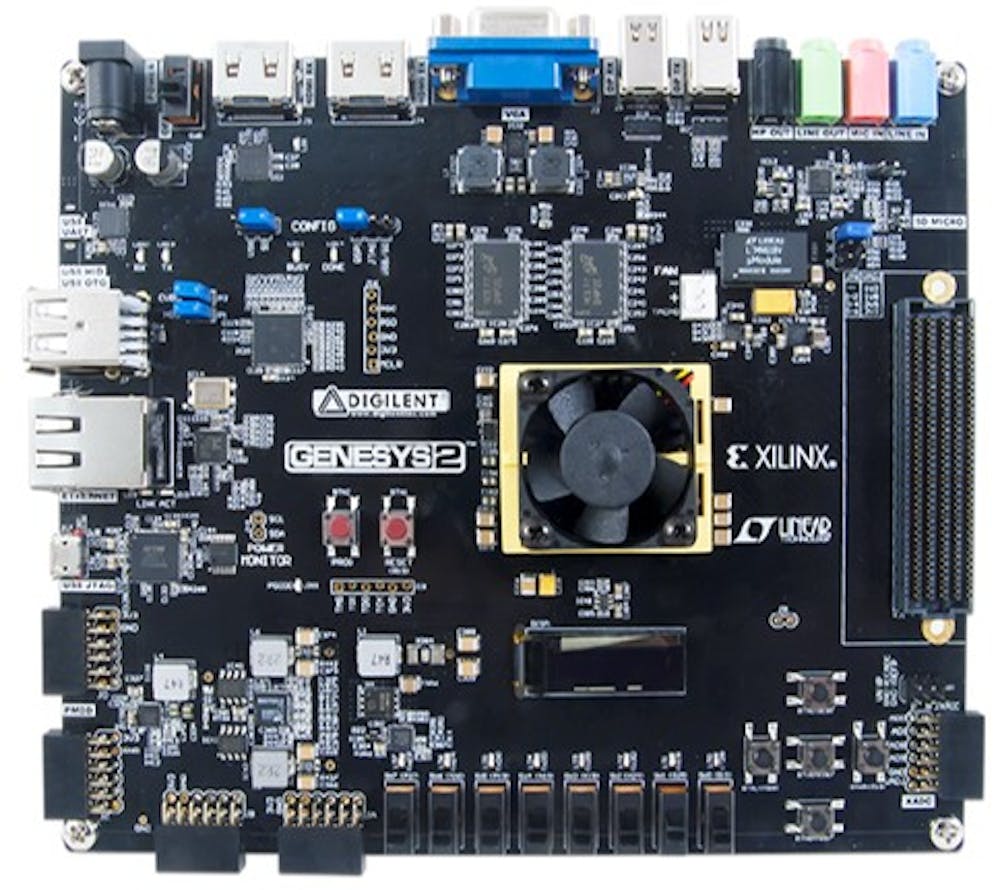
This is what «biomimetic» artificial neurons look like: they are digital microchips. Author provided
V
But most artificial neural networks simulated on computers cannot keep pace with biological time. For example, a supercomputer can simulate one second of a mouse’s brain by several tens of minutes and consumes several megawatts. By comparison, the human brain consumes about 20 watts. To address this, these artificial neurons—developed using neuromorphic engineering—are implemented on a microchip that enables real-time, low-power operation (just a few watts) by performing calculations in parallel.
The Ingredients for Real-Time Communication
We have developed one of the The first real-time neuroprostheses incorporating artificial neurons, and then we decided to establish a more precise connection between the living and the artificial using a recent technique, the’optogenetics.
Optogenetics combines optics and genetic engineering and uses light to stimulate neurons that have been genetically modified to be light-sensitive. As a result of this modification, they produce, or «express,» a a protein that reacts to light, opsin. Blue light activates neurons (increases the frequency of neuronal activity), while red light inhibits them (decreases the frequency of neuronal activity).
What’s the benefit of this system? It enables much faster and more precise information transfer than the electrical stimulation used in previous neuroprosthesis prototypes: the electrodes used in electrical systems are about 10 micrometers on each side and cover, on average, just a few neurons. Optical stimulation occurs over an area of about one micron—similar to the size of a biological neuron—and can operate at high frequencies.
To design this neuroprosthesis, we assembled a microchip containing artificial neurons, biological neurons that had been genetically modified to be photosensitive, and a light source.
Translating the electrical language of neurons into light pulses
The light source is programmable and enables the conversion of the electrical signals of artificial neurons into a light image.
The electrical signals from the chip’s 64 artificial neurons are converted into an image representing the state of the 64 neurons. Remember, a neuron can be in a «stimulated» state or in an «inhibited» state—at rest. An artificial neuron in an «excited» state emits light within its square, unlike a neuron at rest. The image of the artificial neurons—composed of bright blue squares and dark squares—is projected onto an in vitro culture of photosensitive biological neurons that are stimulated by light, just as they would be by neurotransmitters in our bodies.
body.
We record the physiological responses of biological neurons using electrodes.
Synchronization of Neuronal Activity: A First Step Toward Real-Time Communication
Biological neurons exhibit two types of activity: «spontaneous» activity, in which individual neurons fire from time to time, and a form of «synchronization,» in which a group of neurons fires in a chain reaction.
Both of these types of activity can be replicated by artificial neurons. We use the «synchronization» type to establish communication between the artificial and biological systems. When synchronization activity is detected in the artificial system, a stimulus that mirrors this synchronization is sent to the biological network.
As a result, we were able to achieve a high rate of information transfer between neurons by incorporating devices capable of operating in real time: artificial neurons and biological neurons were synchronized in their activity, as if «merged» into a single population.
This work was conducted on in vitro neuron cultures. We are currently developing a new system that will allow us to conduct similar experiments in vivo to better understand how the brain works. However, for future implantable neuroprostheses in humans, the optogenetics technique would not be used, so as not to genetically modify the neurons.
Combining optogenetic stimulation with artificial neural networks holds the promise of significant advances in neuroscience. Spatio-temporal resolution—the ability to target a single neuron or a small group of neurons in real time—is a major advantage for studying communication between artificial and biological neurons, and may lead to the development of functional therapeutic neuroprostheses for humans.