




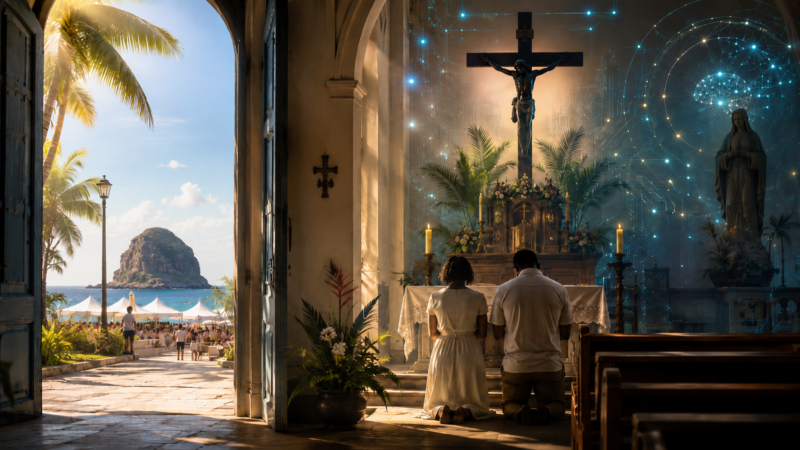
As Ascension Day approaches, Toni Hrițac offers a unique meditation born in the silence of the Church of the Diamond. Between the quiet devotion of a couple at prayer, the power promised by artificial intelligence, and the contemporary rituals of a world fascinated by technology, this op-ed examines our era: What remains of mystery, repentance, and mercy when new «gods» claim to know everything, solve everything, and prolong everything?
Philippe Pied
As we approach the Feast of the Ascension, I would like to share a few reflections that, I am convinced, resonate just as much in Martinique as they do in the rest of the world.
A few days before Easter, I walked into the church in Le Diamant at high noon, in the sweltering heat. The church was almost empty. On the left side, a couple—probably husband and wife—was praying in silence. What caught my attention was the look on their faces: a visible, almost physical fervor. Both were staring intently at the altar, above which was inscribed «Jesus, my Savior; Jesus, my Lord». Their hands clasped beneath their chins, their lips motionless. I had sat in the back on the right, like a tourist—but I quickly realized that my casual demeanor stood in stark contrast to their reverence. I slipped out quietly.
In the small square in front of the church, a phrase came back to me. The day before, on a tech podcast, the magnate Marc Andreessen had claimed that he had no regrets, that he didn’t engage in self-reflection, and that repentance was a recent concept—and a useless one at that. He said this with conviction, despite the fact that it was false—if not downright absurd. The contrast with the scene I had just left was striking. Repentance is the foundation of Christian life: it is through repentance that Christ says everyone can return to God, right up until the very last moment. I realized then, with new clarity, that I was witnessing two radically separate worlds.
These two worlds each have their own ultimate authority. On one side, Christ. On the other, artificial intelligence—which would be nothing special were it not for the staggering power we now attribute to it. For AI is not content to be merely a tool: it promises precisely what has until now been the attribute of the divine—curing diseases, conquering death, dissolving guilt, knowing everything. And a significant portion of the world’s technocratic elites has already begun to devote something resembling a cult to it.
What strikes me is that AI is taking us back to a polytheistic world. Competing gods vying for market share: ChatGPT, Anthropic’s Claude, Gemini, and DeepSeek in China. One Asian god, several Western gods—as if the adventure of humanity’s beginnings were starting over, but this time the ancient Middle East had shifted to America. These new gods have their apostles—Andreessen, Sam Altman, Elon Musk—who don’t promise the salvation of the soul, but specific, material things: deciphering all proteins, defeating cancer, extending life by several decades, perhaps even centuries. They speak of omnipotence without solemnity, with the enthusiasm of a product launch.
Christ, for his part, speaks in parables that two thousand years of debate have not exhausted. He is sought after by all, yet seeks to please no one. AI says it is not human, but it speaks like a human. Of Christ, it was said that he was human—the son of Mary—but that he spoke like God. The new gods are verbose and calculate every syllable, every token. Christ, on the contrary, is a God of mysteries. AI tempts; Christ learned to pray so as not to be tempted.
I felt as though I were witnessing all of this during Easter, as I strolled along the Sainte-Luce coastal promenade. This nearly ten-kilometer-long path through the forest was filled with tents. Hundreds of people were cooking, laughing, and celebrating—just like at the feasts of the early Christian communities. They were listening to music from playlists generated by artificial intelligence. Some young people were gliding across the water on electric foil boards—walking on water, perhaps without even realizing it. And everywhere in the forest, generators hummed, hidden beneath the trees. Electricity is the offering demanded by the new gods—and they are voracious.
I thought that during this almost mystical celebration, at dusk, one could easily imagine Christ walking incognito among all of this. He would probably say, as he once said to men who were deeply attached to their rituals: «It is mercy I desire, not sacrifice.»
Toni Hrițac, journalist, thritac@gmail.com